1 Samuel 18-20; Psalm 11, Psalm 59

So the straw that broke the camel’s back for Saul was the song:

“Saul has slain his thousands,
and David his tens of thousands.”

When Saul hears the song he is infuriated and his jealousy takes over.


Here was my “AHA” moment from the reading.  Remember how all throughout Genesis we would see the Patriarchs make a mistake and then see their son follow in his footsteps or repeat the pattern.  I never saw before the: “Saul sending David to battle as a means to get rid of him….and David follows in his footsteps later!!”


Marriage: To post a picture or not post a picture…that is the question.  Ha!   It was a common practice in the Middle East to collect foreskins just like Native Americans would collect scalps.  David collects 200 when he was only required to collect 100.  You have to imagine Saul’s frustration that this guy just won’t die!!


Michal “wife of the year”.  (She did remind me a lot of Rachel…right down to keeping an idol in her house).

Chapter 20:This chapter reveals that both Saul and Jonathan realized that David was the Lord’s anointed who would one day replace Saul. However, their responses to this inevitable situation were the opposite because their desires were the opposite. Saul wanted to see his own plans fulfilled, but Jonathan wanted to see God’s will be done. Jonathan ended up choosing David, his natural rival, in preference over Saul, his natural father.


This marks the beginning of a “man on the run”.  If you think about any great song on the radio, it is usually written out of a personal experience during hardship or trial. Now is when David will write some of his best worship.  The Psalms.


Psalm 11: As David flees for 14 years he writes Psalm 11 knowing God is in control.

Psalm 59: As I read these I picture David.  A man who can kill thousands of Philistines.  A man you can kill Goliath.  Yet, a man who asks for God to help him during these times.  He KNOWS that everything he accomplishes is not from him, but from God.

Psalm 59 - Believe Trust

1 Samuel 15-17

Chapter 15: I think this chapter is an easy read but I get a lot of texts about a “How can a Loving God, wipe out (completely destroy) women, children, and animals”.  Chapter 15 is a perfect opportunity to break that down.   In verse 3 the Lord gives the command:

‘I will punish the Amalekites for what they did to Israel when they waylaid them as they came up from Egypt. Now go, attack the Amalekites and totally destroy all that belongs to them. Do not spare them; put to death men and women, children and infants, cattle and sheep, camels and donkeys.’”

Think of the Amalekites as cancer and Israel is the body.  Would a good Dr. say “take out most of the cancer, but leave a little in there”?  The Amalekites have been a cancer to the Israelites since day one.  They are brutal attackers that have a history of guerilla warfare.   They attack tribes, stealing their women and children (raping them), and their idolatrous religious practices will always be enticing to the Israelites.  I know if Merideth Grey was the Dr., she would get all the cancer from the body.

Saul disobeys God’s commandment (again).  Agag the king is captured and as Samuel points out “What is that bleating of sheep in my ears?” Saul did not come close to following God’s orders in this surgery!!

However, with love, I say:

Don’t throw a stone at Saul until you can read the Sermon on the Mount and see if you are Saul (do you pick and choose what to obey?  I am not talking about the subtitles: I am talking about the fine print) Click here.


Saul: He is impatient, disobedient, dishonest, and arrogant. But here is the deal, God is never without a plan.  We knew from the beginning Saul was not going to work out because we KNOW that the kingship must go through the line of Judah, not Benjamin!  So if you are not happy when politicians get elected into offices, have heart, maybe God is giving us what we ask for to show us what we really need: The Lord.

Samuel’s response is very important for us to understand because it is said in Psalms 40, Psalms 51, Proverbs 21, Isaiah 1, Jeremiah 7, Hosea 6, Micha 6, Mathew 12, Mark 12, and Hebrews 10!

“Does the Lord delight in burnt offerings and sacrifices
as much as in obeying the Lord?
To obey is better than sacrifice,
and to heed is better than the fat of rams.
For rebellion is like the sin of divination,
and arrogance like the evil of idolatry.
Because you have rejected the word of the Lord,
he has rejected you as king.”

Without question, the offering of sacrifices was an important part of worship in ancient Israel BUT it was an empty ritual without proper motivation and obedience.  Genuine repentance and obedience are necessary accomplishments to the presentation of the sacrifice.   When we deliberately disobey the Lord’s commands, he rejects the sacrifice, in Saul’s case: He rejected him as king.

Samuel ends the chapter as a Judge when he killed Agag.


Chapter 16

A Catholic Notebook: Jesse Tree December 11

At the anointing of David in front of his 7 older brothers, he is empowered with the Holy Spirit and it will remain with him forever.  Simultaneously, God chose to withdraw the Spirit from Saul. (Remember it isn’t until Pentecost in Acts that the Holy Spirit is promised to all believers, so don’t panic that the Lord will do this to you).  An evil spirit (lower case ‘s’) will torment Saul as a means to get David into the palace, sort of like an apprentice.  He is very young and has a lot to learn.

But the Lord said to Samuel, “Do not consider his appearance or his height, for I have rejected him. The Lord does not look at the things people look at. People look at the outward appearance, but the Lord looks at the heart.”

❤️


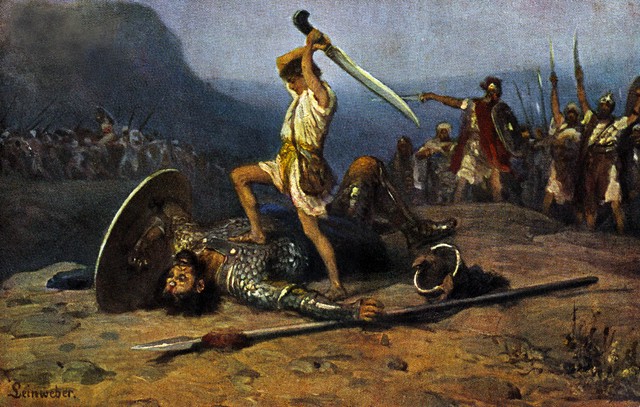
Chapter 17- You can call it David and Goliath (I will call it God and Goliath).  I am going to say something true, ready?  Some of you have grown up in church or have attended church for a long time and you can “tell” this story.  Big guy..little guy…sling-shot… BUT I am betting that there are many of you that have NEVER actually read the whole chapter.  How do I know?  Because until recently I had never read it either (but I had seen veggie tales!)

(By the way, totally irrelevant but if you have HBO, watch the WWF Andre the Giant documentary, it’s fascinating) 😁.

Focus Szymanski!!

Let’s get our geography:Gaza, Goliath, and an end to hatred – Holy Lands Peace Pilgrim

Lessons from Gladwell's David and Goliath applied to the problem ...

(I bet you were expecting the slingshot picture 😋). You know I stay away from making an application or message from the Lord, but I would love t hear what your ‘theme was.

100 days

Here is a Schedule to print: Click here.  We are going to start bouncing around quite a bit soon.  You may want to hang this on your refrigerator.

By the way, if you are keeping up with the reading I want to put in perspective what an amazing accomplishment so far.  It has been 100 days of reading.  14 consecutive weeks.  I hope that your view and relationship with the Lord have changed.  I hope that your view of the Old Testament has changed too. ❤️

I would love to hear what your view of the OT was before a chronological read, and your view now.  99% of you might be reading it for the first time word for word. (with some possible skimming 😂  at times like me 😂)

1 Samuel Overview – Reading the Bible in a Year-2020

1 Samuel 13-14

This section documents Saul’s disobedience that resulted in his disqualification as Israel’s king (well, he’s a Benjaminite and we know that is not the Covenant lines anyway).

Map of the Kingdom of Saul

This map shows that Saul’s KIngdom is quite large and maintains the inland portion of the Promised land.  What we find out in Chapter 14 verse 24 is Saul is a bigger idiot than we thought.  (I am not skipping ahead, just putting it in context).  So evidently, Saul made an oath that no one should eat until they win the battle.  Well, anyone that has played sports or kiddos that play sports KNOWS this is bad idea!  It all comes down to “Is that something the Lord commanded?”

So back to 13, this might explain why he started with 3,000 men and they scattered off and only 600 remained (probably the ones that had an energy bar for breakfast)


When Samuel anointed Saul, he said in 1 Sam 10:8

“Go down ahead of me to Gilgal. I will surely come down to you to sacrifice burnt offerings and fellowship offerings, but you must wait seven days until I come to you and tell you what you are to do.”

Saul violates this command by “acting” like a priest and making his own burnt offering.

1 Samuel 13:1-14 | Samuel bible, Bible clipart

Saul replied, “When I saw that the men were scattering, and that you did not come at the set time, and that the Philistines were assembling at Mikmash, 12 I thought, ‘Now the Philistines will come down against me at Gilgal, and I have not sought the Lord’s favor.’ So I felt compelled to offer the burnt offering.”

13 “You have done a foolish thing,” Samuel said. “You have not kept the command the Lord your God gave you; if you had, he would have established your kingdom over Israel for all time. 14 But now your kingdom will not endure; the Lord has sought out a man after his own heart and appointed him ruler of his people, because you have not kept the Lord’s command.”


The Israelites continue to struggle between their empty stomachs, their lack of a good leader, and now we see they also don’t have weapons. BUT faithful Jonathon knew the Lord would win this battle for them and He did.  He used an earthquake to confuse them and they fight against themselves.

After the men eat and regain their strength, Saul is ready for his men to fight, but when Abijah the priest,  consults God through the Urim and Thummim, there is no answer.  Saul reasons with “someone has eaten!!”  Using the Urim and Thummim again he finds out it is his son.  But the army steps up and protests Saul’s decision to have Jonathan killed since they recognize it was Jonathon’s leadership and faith  (Not King Saul’s) that led the victory under God.

Because of Saul’s consistent lack of obedience to the commands, we will start our transition tomorrow to a new king from a new tribe.

1 Samuel 9-12

Old Testament 3, Lesson 9: Saul Becomes King - Seeds of Faith Podcast

The Lord chose a tall handsome man from the tribe of Benjamin to be the first king. In Exodus,  it was the priests who were anointed with oil, now it will be the king.  A king would be crowned and anointed:

  • crowning was a political act establishing king as ruler
  • anointing was a religious act showing the representation of God (set apart)

Samuel has reserved him the “choice part”- the thigh.  (normally the thigh was reserved for a fellowship offering for the priest).

When Saul leaves,  Samuel gives him some signs that it was God who chose him to be king.  The events predicted when he left all occurred exactly as stated.  This also demonstrated that Samuel truly was a legitimate Prophet (one that speaks for the Lord).

Soon after becoming king, Saul had a chance to prove himself.

For Saul: The Spirit of the Lord will come powerfully upon you, and you will prophesy with them, and you will be changed into a different person” 

For you: Therefore, if anyone is in Christ, the new creation has come: The old has gone, the new is here! Cor: 5:17


Ch 11-  Suddenly,  there is an attack that appears to pop out of nowhere.  The Ammonites were Israel’s enemies to the east. They were descendants of Lot whom Jephthah had defeated earlier (Judg. 11:12-33).  Nahash evidently sought revenge for Jephthah’s victory (Judge) over his nation.  The men of Jabesh-Gilead offered to surrender and serve the Ammonites provided Nahash would make a covenant with them rather than slaughtering them.

Nahash’s purpose to put out the right eye of his enemies was not uncommon in those days. This makes a conquered nation easier to control, and it testified to the conqueror’s superior power. Specifically,  it made aiming arrows with the right eye impossible—and it made looking from behind one’s shield, which covered the left eye, impossible.  Perhaps Nahash’s decision to attack them was because he assumed no one would come to their rescue.

Memory recall: the other day we read about a concubine being cut into 12 pieces, go back in your Bible and look at Judges 21:8

Then they asked, “Which one of the tribes of Israel failed to assemble before the Lord at Mizpah?” They discovered that no one from Jabesh Gilead had come to the camp for the assembly. For when they counted the people, they found that none of the people of Jabesh Gilead were there.

The people from this town did not come to fight against the Benjaminites.  What tribe is Saul from?? 😜


Samuels’s Farewell speech

Just like Moses and Joshua, Samuel did not relinquish his leadership without challenging the nation to be faithful to the Lord.  He challenged them to point out his wrongs to provide an example of future kings.  He reminds them of the past: Egypt, Moses, Aaron, and the Judges.  God would have saved them from the Ammonites even if no king had been appointed.

Will the people put their trust in a human leader at their expense of their faith in the Lord?

If you fear the Lord and serve and obey him and do not rebel against his commands, and if both you and the king who reigns over you follow the Lord your God—good! But if you do not obey the Lord, and if you rebel against his commands, his hand will be against you, as it was against your ancestors.”

“Serve the Lord with all your heart.”


Most people think David was the 1st king.  Now you know…it was a Benjaminite.

Trivia:  If the Lord is going to continue the scarlet thread to the Messiah, will the kingly (is that a word) line stay Benjaminite, or will a different tribe take over the reign?  Let’s do an analogy:

Priests : Levites : KIngs: __________

1 Samuel 4-8

Map 53. The Ark of the Covenant is captured

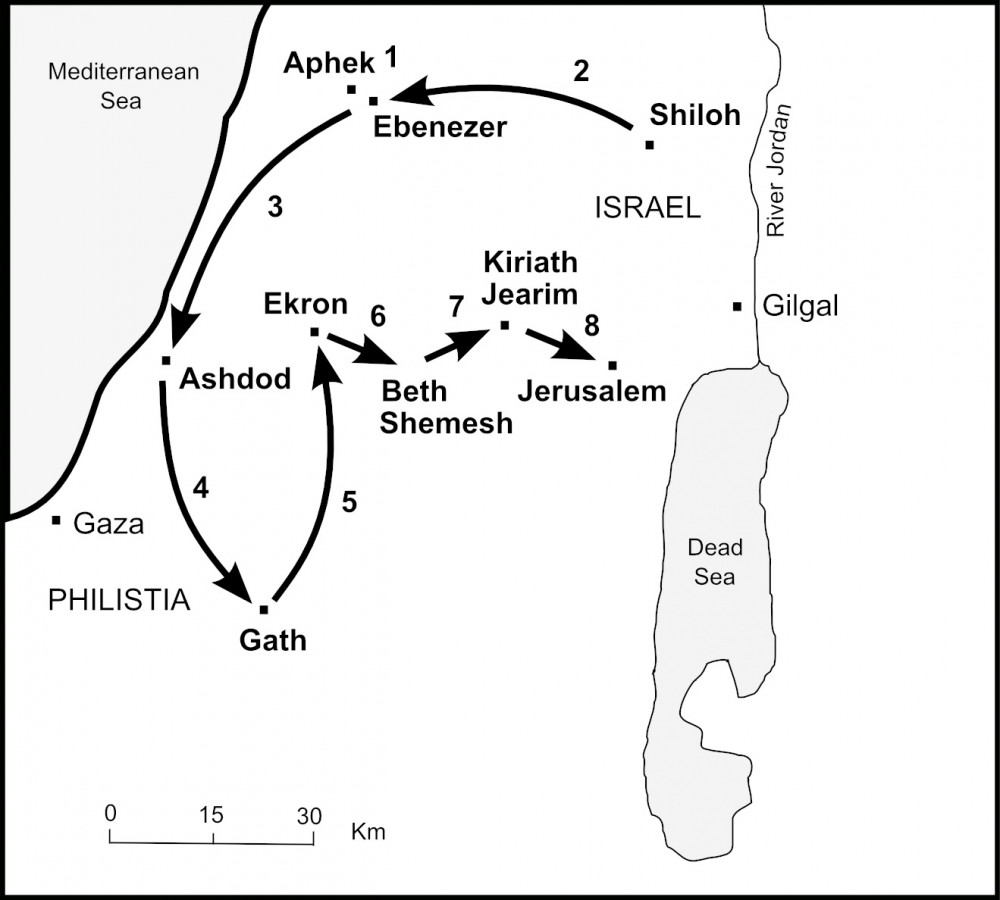
This map might help you follow the reading.  We know the Philistines control the south region, mainly Judah,  but now they are extending north.  The Tabernacle is in Shiloh.  The Phiipstines control 5 major cities-

  • Ashdod,
  • Gaza,
  • Ashkelon,
  • Gath,
  • Ekron.

As the Israelites get defeated they decide to bring the Ark of the Covenant like a “good luck charm”.  We really need you to stop and think about the scene on a personal level.

ONLY 1 day of the whole year (the Day of Atonement) the Hight Priest would go behind the curtain in the tabernacle to make an atonement for all the people. God is HOLY!  HERE we have “scoundrels” Hophni and Phineas with the ark bringing it into the battle scene.  As if God is a genie in a bottle…”ok come out and fight now”.  Good grief!

The ark is captured, the prophecy of Hophni, Phineas and Eli are fulfilled from yesterday’s reading.

(it wasn’t the death of his sons that made him fall back in despair, it was the capturing of the ark ❤️)

Death due to injurious fall that may have been preventable

If you have any interest in following the Priestly line, feel free to print this.  Remember High Priests only come from Aaron’s line. (It reads from the bottom up).  Click here.

Chapter 5: Use the map above to follow the Ark. It is then placed in the pagan temple next to their head god (no pun intended), Dagon.😂. I am a little unglued about this scene.  Our Holy God is set in a pagan temple. 😢😢😢.  How far have they fallen! Dagon was the chief deity of the Philistines.   According to ancient mythology, Dagon was the father of Baal. He was the fish god (dag in Hebrew means “fish”), and he was represented as a half-man, half-fish creature.  Dagon may also have been the provider of grain. So Dagon was similar to many other idols in that he personified natural forces that had supposedly produced all things. Dagon is brought to humiliation by the True God of the Israelites.

The Ark of God and the Fall of Dagon - 1 Samuel 5:1-5

Chapter 6: Meanwhile, the Lord is afflicting the people in the cities with tumors, diseases carried by rats, and death through Ashdod, Gath,  and Ekron.  So let me ask you: if any of their gods are so great…why don’t they help!  They KNOW that LORD is stronger and they want to return their stolen property. To ensure that it is received they send it with gold gifts.  The implications of the cows’  actions would have been obvious to the Philistines that the Israelite God had indeed been inflicting them.  They travel to Beth Shemesh,  a town of Priests (Josh 21:16) who can take the Ark off their hands.Map 53. The Ark of the Covenant is captured

BUT the people in Beth Shemesh (so fun to say) “peek” inside the Tabernacle and 70 people drop dead (as warned in Numbers 4:5).  Distraught at the death of these men they follow the example of the Philistines and send it to Kiriath Jearim to stay in Abinadab’s house. Imagine if someone knocked on your door and said can you watch this for me!  NOW put in your head Kiriath Jearim.  The ark will stay here UNTIL the Lord chooses the place for it’s final rest.

14 Blessed by the Presence Key References: 2 Samuel 6; 1 Chronicles 15; 16; Patriarchs and Prophets, chap. 70, pp. 705, 706; The Bible Story (1994), vol. 4, pp. 82-85; Our Beliefs, nos. 3, 11, 22 power text “But I, by your great love, can come into your ...


Chapter 7.  Finally, a Judge calls them to repentance and the Israelites rid themselves of the chief pagan gods:  Baals and Ashtoreths.  NOW the Philistines were subdued (not permanently).


Chapter 8-  HUGE MOMENT.

  • God as KIng (the 1st five books of the Bible taught this was God’s plan)- Theocracy
  • Foreign gods were worshipped- Anarchy
  • The Israelites want a human king- Monarchy

So all the elders of Israel gathered together and came to Samuel at Ramah. They said to him, “You are old, and your sons do not follow your ways; now appoint a king to lead us, such as all the other nations have.”

Wait?  What??   Isn’t the Lord enough??

And the Lord told him: “Listen to all that the people are saying to you; it is not you they have rejected, but they have rejected me as their king.

Verse 9 God says “warn them before we go forward with their plan”.  So Samuel warns them!

  • a king will draft people into an army (this will happen in ch. 14 with Saul)
  • a king will have young men run in front of the chariots (Abselon will do this in 1 Sam 15)
  • a king will make you slaves (Solomon does this to build the temple and his house_
  • a king will steal your fields (Jezebel will steal Nacoth’s Vineyard in 1 Kings 21)
  • a king will use your property for his own personal gain (Solomon will give land away in Tyre)
  • a king will demand a tenth of your harvest/flocks (Rehoboam wants to tax the people MORE than Solomon)

So after that speech…the people say “We want to be like everyone else…we will take it!!”

Finally,  in verse 21 the Lord says to Samuel “Listen to them and give them a king”.

Buckle up kids!! We are about to be a Monarchy with the 1st king.

1 Samuel 1-3

I posted an overview last night.  Scroll down below this one to see it.

The story of Samuel’s birth is a testimony to his Mother’s faith.  Elkanah had two wives:.  Hannah and Peninnah (Peninnah not nice!).  Hannah is a better person than me and takes her problem to the Lord (I probably would have punched her in the face).

Scripture on Sunday – 1 Samuel 1:21-28 | Theology and Church

Where is the Tabernacle right now? (Jerusalem has not been chosen yet)  It is sitting in Shiloh.

1 Samuel Shiloh - Bible Maps

Eli is now the High Priest at the Tabernacle in Shiloh.  Praying so hard that Eli assumed she was drunk she says:

 “Lord Almighty, if you will only look on your servant’s misery and remember me, and not forget your servant but give her a son, then I will give him to the Lord for all the days of his life, and no razor will ever be used on his head.”

Trivia:  What’s that vow called?  Extra credit: without looking can you name the book/chapter it is from? 🤪

When God gave a barren woman a child it was with a huge purpose.  Well, Samuel is the last Judge to be raised. True to her promise, she gives him to the Lord


Hannah’s Praise in Chapter 2 has the same Praises that Mary verbalizes in Luke 1 when she conceives.

  • God is solid as a Rock
  • He knows what we do
  • Sovereign over all
  • Supreme Judge with perfect justice

Eli’s house is a hot mess! The priests at the tabernacle were provided for but under strict restrictions.  The Lord gets the best part of the offering Leviticus 7:28.  Yet Hophni and Phineas ignored all the restrictions and acted like they were at a buffet.

Paulie | The Priest's Fork

Faced with mounting reports about the wicked deeds Eli’s sons were committing, he confronts them.  Among other things, they were even having sex at the entrance of the tabernacle.  (The women may have been practicing pagan rituals as temple prostitutes like the Canaanites would do at their shrines). As we learned earlier, ignoring the sins of a few affects the whole community.  Eli should have handled it, but chose to ignore it.

God does not let Eli nor his sons go unpunished.   A prophet comes and reminds Eli of his heritage:

Now a man of God came to Eli and said to him, “This is what the Lord says: ‘Did I not clearly reveal myself to your ancestor’s family when they were in Egypt under Pharaoh?  I chose your ancestor out of all the tribes of Israel to be my priest, to go up to my altar, to burn incense, and to wear an ephod in my presence. I also gave your ancestor’s family all the food offerings presented by the Israelites.  Why do you scorn my sacrifice and offering that I prescribed for my dwelling? Why do you honor your sons more than me by fattening yourselves on the choice parts of every offering made by my people Israel?’

As High Priest, Eii was just as responsible for ignoring the Law as his sons.

 “‘And what happens to your two sons, Hophni and Phinehas, will be a sign to you—they will both die on the same day.  I will raise up for myself a faithful priest, who will do according to what is in my heart and mind. I will firmly establish his priestly house, and they will minister before my anointed one always.

This Prophecy will be fulfilled (obviously) in 1 Kings 2 when Solomon removes Eli’s line from the priesthood and raises up a new priest Zadok. (I am sure there is Messianic prophecy here too)


Chapter 3

Samuel begins his relationship with the Lord.  (I cannot even begin to tell you how similar the “calling” is to my own life.  At 33 years old I heard the Lord for the first time, thinking it was people around me too.  Samual affirms the prophecy for Eli.  The Lord was with Samuel and all the people attested Samuel as a prophet to the Lord.

What is the one part of this reading that you underlined (with a pen or with your brain)?  Please share.

1 Samuel 3 NIV

1 Samuel Overview for tomorrow

Samuel: “the name of God”, root  is “Hearer of God”

1 and 2 Samuel were actually one book in the Hebrew Bible.  One will immediately follow the other.  Samuel is the last Judge to be raised up and we now will segway into the time of the kings.  1 Samuel will cover a period of about 500 years bringing us to about 586 BC when we are done. (the Old Testament ends at around 400 BC) WOW!

This book will cover 3 men that we will recognize by name: Samuel, Saul, and David. The days of the Judges were dark until God raised up Samuel, a prophet, a priest, and a judge.  Samuel was committed to doing what was right in God’s eyes.  Unfortunately, the people will still want a king appointed to them.  God left them with Theocracy, a government under God.  As we read in Judges ”

In those days Israel had no king; everyone did as they saw fit.

The Israelites refused to recognize God as their leader and King.  They want an earthly King.  This is called a “Transition Book”.  We will transition from Judges to Kings.   Now we will see the transfer to a monarchy, and then eventually a divided monarchy.

We also need to remember that the Ark of the Covenant, the tabernacle we read so much about has been in the same place, Shiloh.  Shiloh is where God stopped the Ark from moving forward (with the cloud and fire by night), so there it remains.

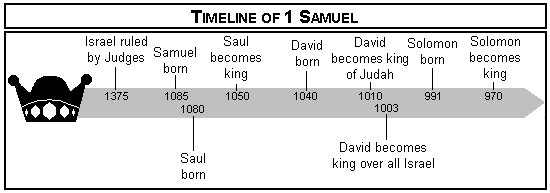
If you did not print the Timeline earlier and want it now (all handouts are on the sidebar) Click here.  Look how far we are!!!!

Do you have this handout? | Bible timeline, Understanding the ...

Ruth 1-4

Before we even start let’s recall the ending of Deuteronomy.  The Lord spoke through Moses about the blessings and curses upon entering the Promised Land.  One of the curses was famine…

Ruth Chapter 1:1

In the days when the judges ruled,  there was a famine in the land. So a man from Bethlehem in Judah, together with his wife and two sons, went to live for a while in the country of Moab. The man’s name was Elimelek, his wife’s name was Naomi, and the names of his two sons were Mahlon and Kilion. They were Ephrathites from Bethlehem, Judah. And they went to Moab and lived there.

So we know the setting of this book.  Now let’s have some fun and break down the names.

  • Elimelek- El (Lord) and the i (means “my”) melek (King)   “My God is King”
  • Naomi- Pleasant
  • Mahlon-sick or weak
  • Chilion-crying

So Elimelek, not living up to his name, left Bethlehem to live in Moab….C’mon, you can remember this one…who started the Moabites??  Clue: Lot, mountain top, daughter,  beer, gross.  The Moabites, after all, were horrible people.  They were the people that tried to get Balaam to curse the Israelites as well as the ones that strongly worship foreign gods.

Elimelech and his wife went to Moab and his sons married Moabite woman.  After the sons had died, Noami was heading back to Bethlehem and told her daughters-in-law to go back to their families.  Orpah returns to her family and her gods BUT Ruth changes the course of history when she says :

“Don’t urge me to leave you or to turn back from you. Where you go I will go, and where you stay I will stay. Your people will be my people and your God my God. Where you die I will die, and there I will be buried. May the LORD deal with me, be it ever so severely, if even death separates you and me.” When Naomi realized that Ruth was determined to go with her, she stopped urging her.

Ruth uses the word Yahweh in this verse.  LORD-All Caps. When you read your Bible and you see all caps it is referring to the name Yahweh.  This is a profound statement.   A conversion statement.  Yahweh is the name God uses at the burning bush to explain WHO He is...”I AM who I AM”.

Get this! Ruth pledges to become an Israelite!  Her commitment to Yahweh discards all alliances with social, religious, and political ties to the Moabites.  She is now a citizen of the land until death.  This changes her ethnic identity and religion.  She commits to the Law when she says “may The LORD deal with me”.  Ruth does what few Israelites do: commit to the LORD and opposes all other gods.  THIS is what will open the door for her to marry an Israelite in the future. She is Converted.

Ruth and Naomi (well, Naomi wants them to call her by her new nickname “bitter” since she has lost her husband and her sons) head back to Bethlehem as the barley harvest begins.


Chapter 2-

Boaz- a person from Elimek’s family- the Tribe of Judah

  1. He goes beyond the mandate to leave food for the poor in the field to let them “glean”. (Duet 24:19-provisions for the poor.)  He takes it a step further by feeding her a meal and protecting her.
  2. He recognizes her loyalty to Naomi
  3. He understands that Ruth’s identity has changed through her conversion to follow Yahweh when he says “May you be richly rewarded by the Lord, the God of Israel, under whose wings you have come to take refuge.”

Boaz is a man of character, wealth, “a man of standing’, but he is ALSO a relative described as a kinsman-redeemer.  The law states in Leviticus 25 and Deuteronomy 25 that a male, near relative, has the responsibility of rescuing, protecting, and helping weaker relatives.  His responsibilities might include buying back land they may have lost, defending legal issues, or raising children with the wife of a deceased relative, even marrying a brother’s widow to extend the family.


Chapter 3– In short, Ruth proposes to Boaz.  (I have studied this book before and there are different interpretations on the “feet” since the same Hebrew word was used for another male part, but we will stick with feet for this reading 😜)  Boaz accepts her proposal- however, following the law, he states that there is a kinsman that is closer to her and gets first dibs.


Chapter 4 – If you want to re-read this chapter circle any variation of the word Redeem or Redeemer.  It is obvious it is the climax of the book.  Boaz meets the relative at the city gates (where legal matters were held) and shows up with this in his hand (but still sealed)

Old Deed Images, Stock Photos & Vectors | Shutterstock

A land deed was a scroll with a seal.  The only one who could open it was the Redeemer.  The relative says he will buy the land BUT he hears that Ruth comes with the deed.  For personal reasons (maybe already married), he lets Boaz be the Redeemer. (He is the only one now worthy to open the scroll…who knows where I am going with this 😁). If you have read Revelation you get it.

Next, the witnesses bless Ruth and Boaz wishing her to be the matriarch of Israel and Boaz to be famous in Bethlehem.  Indeed!!


The Genealogy Ending- Click here to print- Remember, we are following the scarlet thread to the Messiah.  Really soak this genealogy in.  This is the line that will does through King David.  When we get to 2 Samuel 7, God will give an unconditional Covenant that the Messiah will come from the line of David.  Ruth is in the genealogy!


In the comments tell me why I talked about the deed as a scroll if you think you figured it out.


Just for the fun of it, click here and read the beginning of the Gospel.❤️


Ruth Overview for tomorrow

Tomorrow we will read the entire book of Ruth in 1 day.  It’s actually only 85 verses. (It is less than a 14-minute read) This is one of the only two books in the Bible named after a woman: Ruth and Esther, and they stand in marked contrast. Ruth is a young Gentile woman who is brought to live among Hebrews and marries a Hebrew husband in the line of David. Esther is a young Hebrew woman who is brought to live among Gentiles and marries a Gentile husband.

To me this book is CPR!  Conversation, Providence, and  Redemption.

  • We will see true conversion since Ruth actually becomes a follower in ‘Yahweh’ (The LORD, not just a lord).
  • Providence-natural events used for supernatural outcomes-(this is my favorite theme of the book).
  • A kinsman-redeemer is a male relative who, according to the law, had the privilege or responsibility to act on behalf of a relative who was in trouble, danger, or need. (Jesus)

I think often I view the Bible as “orchestrated”, when in fact we know that God will use natural circumstances to fulfill His plan.  This book God uses Providence for these prophecies to occur one day in the future:

  • The Messiah will be born in Bethlehem: Micah 5:2
  • The Messiah will come from the tribe of Judah: Genesis 4:10
  • The Messiah will be born through the family of David: 2 Samuel 7

God uses natural events during a very dark period in history for supernatural outcomes.  (Please read that again if you are in a dark place.  God uses natural events during a very dark period in history for supernatural outcomes.  He

will create a genealogy in chapter 4 that will continue the perfect prophecy of Jesus.

Ruth Chapter 1 verse 1: In the days when the judges ruled, there was a famine in the land…