Psalm 89, 96, 100, 101, 105, 132


Psalm 89: What could I possibly write after reading that??  I hung on every word.  Overall, I want to point out that for first-time readers this is a movie trailer for tomorrow’s read.
You said, “I have made a covenant with my chosen one,
    I have sworn to David my servant,
‘I will establish your line forever
    and make your throne firm through all generations.’”
2 Samuel 7 is one of those chapters you need to put in your brain.  The rest of our year will look back to it.  For example, we KNEW the Hebrews would obtain the Promised Land BECAUSE God made a Covenant with Abraham.  BUT, God also told Abraham that He would bless all the nations through him.  The Davidic Covenant sits layered on the Abrahamic Covenant.

Davidic Covenant: This is an unconditional covenant made between God and David through which God promises David and Israel that the Messiah (Jesus Christ) would come from the lineage of David and the tribe of Judah and would establish a kingdom that would endure forever. The Davidic Covenant is unconditional because God does not place any conditions of obedience upon its fulfillment. The surety of the promises made rests solely on God’s faithfulness and does not depend at all on David or Israel’s obedience. (Thank Heavens)

You said, “I have made a covenant with my chosen one,
    I have sworn to David my servant,
‘I will establish your line forever
    and make your throne firm through all generations.’”
20 I have found David my servant;
    with my sacred oil I have anointed him.
21 My hand will sustain him;
    surely my arm will strengthen him.
22 The enemy will not get the better of him;
    the wicked will not oppress him.
27 And I will appoint him to be my firstborn,
    the most exalted of the kings of the earth.
28 I will maintain my love to him forever,
    and my covenant with him will never fail.
29 I will establish his line forever,
    his throne as long as the heavens endure.
After the Covenant tomorrow – will the people be perfect?? Not even close! BUT…BIG BUTT!!
32 I will punish their sin with the rod,
    their iniquity with flogging;
33 but I will not take my love from him,
    nor will I ever betray my faithfulness.
34 I will not violate my covenant
    or alter what my lips have uttered.
Take the time now to see the foreshadowing of Jesus.  Click here and replace David with Jesus and the Covenant of the Cross for you and me.  💜

Psalm 96:  I KNOW your pen underlined something that was JUST for you. God’s personal reminder that He is reading WITH you every day.  One scripture personally stood out to me that would not have stood out before.  It’s personal.  He is with me.  Emmanuel.


Psalm 100 : 💚


Psalm 101.  YIKES.  Did you catch the word “I”.  Usually, we read the Psalms and it is a reminder of what HE does or will do.  Well, my little grasshoppers…Ask not what your country will do for you but you will do for your country!”  Look at the “I”s on this one. Before you re-read this Psalm (like I say to my students, “that was not a question, that was a direction”) Read part of Proverb 6:
16 There are six things the Lord hates,
    seven that are detestable to him:
17         haughty eyes,
        a lying tongue,
        hands that shed innocent blood,
18         a heart that devises wicked schemes,
        feet that are quick to rush into evil,
19         a false witness who pours out lies
        and a person who stirs up conflict in the community.

Psalm 105:   If I were to title this Psalm it would be “Exodus Recap”.  But ‘for me’ it is titled: “Szymanski, are you teaching God’s history to your children??” I am failing.

Psalm 132– One of the Ascent Psalms.  Psalm 120-134 were sung on the way to the Temple as they ascended the mountain to the Temple.

“Let us go to his dwelling place,
    let us worship at his footstool, saying,
‘Arise, Lord, and come to your resting place,
    you and the ark of your might.
May your priests be clothed with your righteousness;
    may your faithful people sing for joy.’”

Psalms 1,2,15,22,23,24,47, and 68


Psalm 1: The translated word for “Blessed” here is “Happy” and “Wicked” can be translated as “Sinner”.  This Psalm stands apart from most Psalms as sort of an Epilogue to the book.  Only 3 Pslams are called “Torah” Psalms and this is one of them.  The Psalm is about our attitude toward the law.  How fitting after yesterday’s read about the Ark incident.   We spoke weeks ago about threshing the wheat: how they would throw the stalks in the air.  The useless chaff would blow away in the wind but the good part would remain.  We have 2 choices to make.  Blessed Happy Life or Wicked Sinner’s life?


Psalm 2: This is the most quoted Psalm in the New Testament=18 times!  As Psalm 1 deals with two ways that individuals may follow,
Psalm 2 deals with two ways that nations may follow. This is categorized as a “Royal Pslam” since the king “installed” refers to David however it is also a “Messianic” Psalm since it also refers to the Messiah as The King.


Psalm 15:  You have to picture the scene.  David lives in a castle and the Ark of the Covenant (a symbol of God) is out his window living in a tent.  As he gazes up in he says:

Lord, who may dwell in your sacred tent?
    Who may live on your holy mountain?

The answer is:

  1. One that speaks the truth
  2. One that does not slander other people.
  3. One that does not do evil to his neighbor
  4. One that does not gossip or use information that would discredit others
  5. One that does not approve of those who turn away from the
    Lord
  6. One that keeps his promises even when it costs him to do so.
  7. One that does not charge interest on money he loans
  8. One that does not pervert justice for his own advantage

Psalm 22-24  These three Psalms are read together as a “triptych of tablets”.   A triptych is a set of 3 pictures that create one scene. Like this:Pheasant Feather Triptych Framed Print, slide 1 of 11


These 3 Psalms read together is a Triptych of the story of the Christ as

  • Saviour
  • Shepherd
  • and King

(The Cross, The Crook, The Crown)

THE CROSS, THE CROOK, AND THE CROWN - Margaret Street Church of Christ

When you begin Psalm 22 (A Messianic Psalm)  you may have recognized it,  however, if you didn’t: Jesus quoted this on the Cross.  A Psalm when you feel the Lord has abandoned you.

My God, my God, why have you forsaken me?

Read this Psalm and picture Jesus hanging on the Cross, taking on all that sin and pain, and this is the Psalm that he is whispering in his head.

Dogs surround me,
    a pack of villains encircles me;
    they pierce my hands and my feet.

 All my bones are on display;
    people stare and gloat over me.

 They divide my clothes among them
    and cast lots for my garment.

Then Jesus puts His trust in HIm, even though He feels deserted.  (I literally could cut and paste this whole Psalm into this)

Ending with It is finished:

They will proclaim his righteousness,
declaring to a people yet unborn:
He has done it!


Psalm 23- Familiar Psalm, especially if you have seen Pulp Fiction!  You have to read Psalm 22 to read Psalm 23, they purposely contrast each other.  P 22 maintains confidence in the Lord even though he feels abandoned and has been physically ripped apart.  P 23 is the opposite, it is about feeling his personal current protection as you walk through this world.  This is a PERSONAL Psalm.  Take note to the “me”, “my” “I”:

Psalm 23 – Reloaded | Psalms, Psalm 23 words, Psalm 23


Psalm 24: Finally, the Lord as King.  We don’t know when this was written by David,  but it would make sense that these words have flowed as he moved the Ark towards Jerusalem ascending up the mountain.  I read this one several times and the repeat of “The King of Glory’ made me feel like David just couldn’t get the right words to describe our God as King.  There really are no words!


Psalm 47– This is an “Enthronement” Psalm.  If you have looked on your calendar you may have seen the words “Rosh Hashana”.  The Jews use this psalm on Rosh Hashana, the Jewish New Year’s Day, and some Christians use it as part of the celebration of Ascension Day.  What is Ascension Day?  40 days after Easter to celebrate Jesus’ ascension into heaven 40 days later.  I LOVE that some of you are like “What??  He hung around for 40 days!  I didn’t know that!”

(May 13, 2021 if you are interested) ❤️


Psalm 68

What was the verse that fell FRESH  on you this morning,  or your pen underlined, or maybe you read it twice? Or a song that came to mind?

I love you guys.  Have a wonderful day.

2 Samuel 5:11-6:23 and 1 Chron 13-16

Everyone has their own way of studying…this is how I study this section:  I read 2 Samuel.  I research and study.  Then I read 1 Chronicles.  If at that point I understand 1 Chron, then I know I am “good to go”.  I also look to see which section is longer.  When I see 1 Chronicles is longer I know it is a “good” read because Ezra usually only wrote about obedience, not failure. (so if you see Samuel is the linger book…☹️


2 Samuel

Well, David has been busy making babies.  Refer to the David Genealogy we printed. (click here). (Lacey I mailed this one to you)

\

David is no stranger to the Philistines.  Since the day of Goliath, the name Philistines has been in his life.  They have been enemies but David has been in their land hiding from Saul.  They grew accustomed to David being around until they heard he wasn’t JUST the king of Judah, now he has been anointed the King of Israel (and Judah).  You can see now the Philistines see him as a threat.  David,  even as a king, consulted with the Lord on all his decisions (for now).  Here is a map to go with the read.

Map of the Territory of the Philistines (Bible History Online)


Chapter 6

If you went back to 1 Samuel 6 and 7 you would remember that the Ark was stolen by the Philistines and then when it was returned it was kept in a house….in a house!!!  Could you imagine the knock on the door that day!

1 Samuel 7:

So the men of Kiriath Jearim came and took up the ark of the Lord. They brought it to Abinadab’s house on the hill and consecrated Eleazar his son to guard the ark of the Lord. The ark remained at Kiriath Jearim a long time—twenty years in all.

So this sweet boy named Uzzah puts his hand out and touches the Ark when the oxen stumbled, and The Lord was so angry He struck him dead right then and there.  If this is your first time reading this story this may seem harsh…I mean c’mon his heart is in the right place!  Oh, how I have used that phrase many, many times….”Well, her heart is in the right place”.  I even use it on myself “Well, I am going to do that or not do that…it doesn’t really matter because my heart is in the right place!  No!  The scriptures don’t affirm that, it is black and white…do what is right!

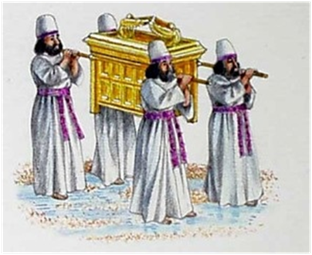
  • Why is the Ark on a cart?? I may have skimmed a little during some of the law (only when it was repeated I promise) BUT I definitely would have remembered a cart. (If God had used a southern woman to write this, it would have been called a Buggie 😂)  God is Holy and He will be treated as Holy.  ONLY members of the Kohath family in the Tribe of Levi are to carry the Ark using the special poles, like this:

E28-2: Why the term 'LEVITE PRIESTS' is misleading - WELCOME TO ...

  • Is Uzzah from the Kohath tribe?
  •  The Ark is NEVER to be touched.  Ever!  That’s why we have special poles!
  • God did not stumble…the Ox did!

If God had ignored this scene as they were bringing the Ark (The Lord) to Jerusalem He would be dismissing the process of how we spiritually and physically approach God.  If God had ignored this moment it would have said “All that I have taught you about who “I AM’”, was wrong and you don’t have to follow my decrees, as long as your heart is in the right place.  This has to be one of the best stories in the Bible to think about all day.  How do we view or approach the Lord?  Has Uzzah been living with The Ark in his house for so long he has grown “too comfortable” with the Presence of the Lord (ouch, right)?   I am so sorry if you like the song “I am a friend of God”, but it drives me crazy!  He is the Almighty, All-Knowing, All-powerful, Creator of the Universe!`Uzzah may have had his heart in the right place but how he approached the Lord was wrong and God used this as a HUGE “teachable moment” for David and the Israelites.

So what appears to be a harsh moment in the Bible is the absolute opposite.  What should the consequence have been for all of them that day?  What should the consequence be for us?  Today is a great day to take a step back and think about our reverence for Our Lord.


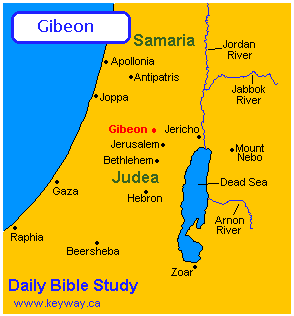
David himself took a 3-month “moment” to collect himself and move the Ark correctly.  Again, could you imagine the knock at the door at Obed-Edom’s house?  The Ark eventually will be in Jerusalem.  As David returns and follows the directions for properly moving the Ark, he brings it to a town called Gibeon, about 6 miles just outside the town of Jerusalem.

Map Of Campaign Against The Philistines - Ark Of The Covenant Journey (1000x900), Png Download


1 Chronicles: Besides the awesome detail (for geeks like me), how amazing is it to read Asaph and how the Psalms are incorporated.  I tend to think of them as scrolls that were written.  They were sang, read, memorized..used!

The next 2 days are Psalms.  Please mark your calendar for May 7th as we turn the page to 2 Samuel 7 and 1 Chronicles 17.  Let’s call this 7-17!  It is a HUGE HUGE READ that without it, I don’t know how anyone reads the New Testament!

Psalm 106-107

After I read the Psalm I thought about the other day when I asked what your favorite scripture was and many of you referenced:

“The Lord is compassionate and gracious, slow to anger, abounding in love.”

Psalm 106 references 34 examples of sin, and how does God react??‭‭ He saves them for HIS name’s sake. (Verse 8) and then reverses the reason in Verse 45: for their sake he remembered His COVENANT. ❤️

I found this to be a bittersweet read recounting my own list of sins, and his patience and abounding love that keeps him slow to anger.


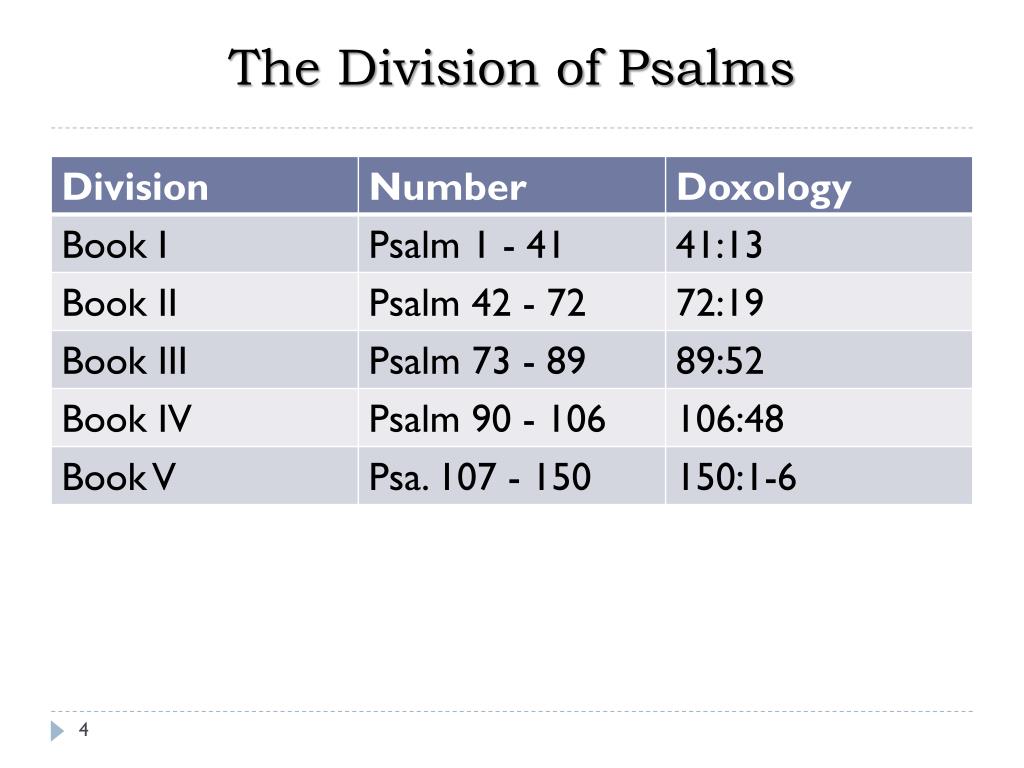
The next Psalm starts a new division.  Psalm 107 is the first of Book 5.  If you notice they are separated with a Doxology.  A Doxology is an expression of  Praise.  Below I will attach the Doxologies of each section if you are interested.

PPT - A Study of Israel's Hymn Book PowerPoint Presentation, free download - ID:5368626


Psalm 107– A Psalm of Thankfulness.  This Psalm mentions 4 different times the Lord delivers his people and then this beautiful chorus that follows in verse 8,15, 21, and 31 of Thankfulness.

Let them give thanks to the Lord for his unfailing love
    and his wonderful deeds for mankind,

15 Let them give thanks to the Lord for his unfailing love
    and his wonderful deeds for mankind,

21 Let them give thanks to the Lord for his unfailing love
    and his wonderful deeds for mankind.

31 Let them give thanks to the Lord for his unfailing love
    and his wonderful deeds for mankind.

If you have ever been to a Catholic mass, something similar is repeated in chorus from the congregation.


Click here for a song (this is the first one I thought of, but I am sure some of you may recommend a better one?)


Psalm 133

How fitting to read as we ended yesterday with the Israelites coming together to celebrate David as King of Israel.  The tribes were united for a brief time.  David gives two examples to try to imagine how God must feel when His people are actually united as one body.

The oil running down the head of the High Priest.  The priest was the connection between God and his people.  God flowing down onto us directly.

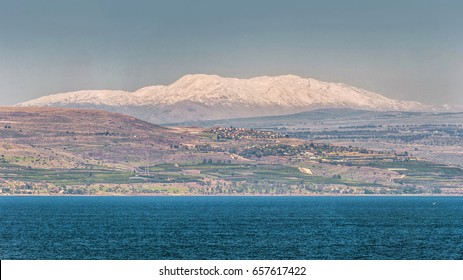
Unity brings life that can thrive.  The dew that flowed down from Mt. Hermon.  God is represented in this Majestic Mountain, standing at almost 10,000 feet for everyone to see.  The Rock that brings life.  Mt. Hermon was the water source that fed into all the seas in the Promise land.  Mt. Hermon was the life of Jerusalem.

Profile of Isreal

Mount Hermon Israel Images, Stock Photos & Vectors | Shutterstock

The downward flow of the oil and the dew represents the downward flow if God’s blessings on his people when we are united.

Imagine if we as a church were united??

Psalm 133

A song of ascents. Of David.

How good and pleasant it is
    when God’s people live together in unity!

It is like precious oil poured on the head,
    running down on the beard,
running down on Aaron’s beard,
    down on the collar of his robe.
 It is as if the dew of Hermon
    were falling on Mount Zion.
For there the Lord bestows his blessing,
    even life forevermore.

2 Samuel 5:1-10 and 1 Chronicles 11-12

Just like when we read Matthew, Mark, Luke, and John, we read the same time period from different perspectives intended for different audiences.  That is how we will be reading for a little while.  Many of you will prefer 2 Samuel, others will prefer the Chronicles.  What is important is not what is the same but looking for what is different.  The Chronicler is going to depict David’s victories and the support from the nation in stark contrast to the struggles David has through  1 Sam, 2 Sam, and the Psalms.

Think about it, look at our textbooks on World History, how do they depict America to the next generation?  Do they choose to write about the victories or the failures?  Well, the Chronicler is writing a textbook for the next generation.


2 Samuel 5:1:10

This is the 3rd anointing of David.  The first one was a private ceremony with Samuel (1 Samuel 16:13), then he was anointed king of Judah (2 Sam. 2:4), finally, David was so patient to wait on God’s timing to “King him” over All of Israel.

When all the elders of Israel had come to King David at Hebron, the king made a covenant with them at Hebron before the Lord, and they anointed David king over Israel.

David was thirty years old when he became king, and he reigned forty years. In Hebron he reigned over Judah seven years and six months, and in Jerusalem he reigned over all Israel and Judah thirty-three years.

JERUSALEM- What a huge moment. A few reads ago we were talking about Mt. Zion (Jerusalem), in the Psalms and I showed you this:

Jerusalem | All Geography Now

Mt. Zion is 2,540 feet above sea level, and to make it even harder to conquer is it sits on top of a Valley 1,300 below sea level.  When David marched out to conquer it, the Jebusites laughed!  “Even the lame and blind would be able to fight off an army trying to take this city.”  Well, David had a secret weapon….The Lord! ❤️  David used the water shaft to gain entrance and took over the city called “The City of David”.  I have not been to Israel but I know some of you have and you can still see Warren’s shaft today.  Amazing!

On that day David had said, “Anyone who conquers the Jebusites will have to use the water shaft to reach those ‘lame and blind’ who are David’s enemies” That is why they say, “The ‘blind and lame’ will not enter the palace.”


If the story is a major victory like this one, the Chronicler is to love writing about it.

1 Chron 11 and 12

The focus here is God. Jerusalem is centrally located, about 11 acres, with deep valleys on 3 sides, and possessed an excellent water source.  David takes immediate action to fortify the city as his capital.  David’s capture of Jerusalem was foundational to all the political and religious events that will follow.

David honors the Lord for this defeat by pouring his drink (as a drink offering) to the Lord. Chapter 11 closes with giving credit to the military men who risked their lives,  starting with “The Three”.

DAVID'S THREE MIGHTY MEN OF VALOR | rockdoveblog

David’s Men (his inner circle) and the additional 30 are named as loyal warriors that provide protection for King David.


Chapter 12- The chapter is split in half showing the support David received before and after king Saul going back to the days when David was in Ziklag.  I particularly like the verse that ends the first half:

22 Day after day men came to help David, until he had a great army, like the army of God.

Starting in verse 23 the Chronicler shows the support from ALL the nations for David after the death of Saul.  We end with the entire nation gathered around David celebrating his kingship.

They came to Hebron fully determined to make David king over all Israel. They were one mind to make David king.