Proverbs 1-3

Proverbs 1:1-7

My Bible calls this first section the purpose and theme, I think of it as a mission statement.

The proverbs of Solomon son of David, king of Israel:

for gaining wisdom and instruction;
    for understanding words of insight;
for receiving instruction in prudent behavior,
    doing what is right and just and fair;
for giving prudence to those who are simple,
    knowledge and discretion to the young

let the wise listen and add to their learning,
    and let the discerning get guidance
for understanding proverbs and parables,
    the sayings and riddles of the wise.

The fear of the Lord is the beginning of knowledge,
    but fools despise wisdom and instruction.

  • “Fear of the Lord” is used 50 times in the Bible,  18 of them will be in the Book of Proverbs.

V. 7- This phrase does not mean to cower in terror or to feel a threat.  To fear the Lord means to respect-absolute reverence for someone.  It is the same word used in places of the BIble to explain the respect children should have for their parents.  Here is a phrase I read recently “Fear of the Lord is Reverential AWE that produces humble submission to a loving God based on a relationship, not repercussion.”

The scripture says this is the beginning.  The beginning is the foundation on which all instruction will be placed.  So before you read any further take a moment to reflect on your view of where you acquire knowledge?

  • V: 8-9 is an introductory call to pay attention to those instructions and the benefits of doing so
  • V:10-14 is the warning against yielding or ignoring these instructions
  • v 15-19 discusses the reason for doing so.

Starting in verse 20 you will see Wisdom is personified: it is given a feminine pronoun.  She seeks to rescue us from our errors.  When we ignore her, we will face consequences therefore by verse 28, we will call out for help.  The phrase that hit me was 31: “They will eat the fruit of their ways…but in 33 it says “but whoever listens to me will live in safety and be at ease without fear of harm”(PEACE).  I want the latter!


Chapter 2– starts off strong!

  1. ACCEPT these words,
  2. then HEAR these words,
  3. then APPLY these words.

So if you TRULY want wisdom, you will have to dig into these Proverbs:

verse 4:

and if you look for it as for silver
    and search for it as for hidden treasure,
 then you will understand the fear of the Lord
    and find the knowledge of God.

Here is a kick in the stomach: The time and effort I put in looking for my phone when I can’t find it is greater than the effort I put into seeking God’s wisdom when I can’t hear it.  Ouch!  (btw, the other day I spent 30 minutes looking for my phone, finally, I said “mom, I am going to have to call you back, I can’t find my phone). If you get it…then you understand my life!

The ultimate source of Wisdom is found in the hidden treasure:

For the Lord gives wisdom;
    from his mouth come knowledge and understanding.

In verse 16 we are introduced to the other female- “the adulterous woman”.  She represents what we “want” not need.  This woman will tempt us but through God’s wisdom, we can resist giving in to sin. (we will talk about that in more detail in upcoming chapters)

Verse 20-22 gives the example of living in the land which we can now look back on historically and understand the correlation.  When the Israelites followed God’s commands they had Peace in the land when they strayed from his commands they fell into their own consequences.


Chapter 3:

  • Verse 1-4  again talks about the advantages of holding on to God’s wisdom.
  • Verse 5- I am betting many of you underlined this familiar scripture:

Trust in the Lord with all your heart
    and lean not on your own understanding;
 in all your ways submit to him,
    and he will make your paths straight.

Wisdom is more profitable than silver, rubies, and gold.

Pile of gemstones | Semi precious gems, Gems for sale, Gems

The chapter ends with “do not” phrases. What not to neglect and what not to engage in.

Ok, if we don’t do a read-through in 2022 THEN we have to at least come back to Proverbs, that was AWESOME!!  I underlined almost every word!

Psalm 119:89-176

Doing a Chronological read-through is HARD.  It shouldn’t be.  It’s not that time-consuming if you think about it.  It is about making it a priority.  So if you have been reading with me for 152 days, I am so proud of you. ❤️  I warn you though, doing a “bible study” (book or workbook) won’t be the same.  You will know more than the leader of the group now.  You are “bible study wrecked’ (what a great place to be.)

Look for patterns that YOU see.  If one word catches your eye over and over, God is talking to you.  I will put my “Word” in the comments so that you don’t see it when you read and you see your own word.  But notice that Psalm 119 is about His Word:

There are eight different terms referring to the Word of God throughout the psalm: lawtestimoniespreceptsstatutescommandmentsjudgmentsword, and ordinances. In almost every verse, the Word of God is mentioned. Psalm 119 affirms not only the character of the Scriptures, but it affirms that God’s Word reflects the very character of God Himself. Notice these attributes of God in Psalm 119:

1. Righteousness (verses 7, 62, 75, 106, 123, 138, 144, 160, 164, 172)
2. Trustworthiness (verse 42)
3. Truthfulness (verses 43, 142, 151, 160)
4. Faithfulness (verse 86)
5. Unchangeableness (verse 89)
6. Eternality (verses 90,152)
7. Light (verse 105)
8. Purity (verse 140)

I keep going back to verse 9:

How can a young person stay on the path of purity?
    By living according to your word.
10 I seek you with all my heart;
    do not let me stray from your commands.
11 I have hidden your word in my heart
    that I might not sin against you.

How can we put it into our hearts if we don’t read it?

Read slow today.  Feel free to comment 😁.


1 Kings 3-4, 2 Chronicles 1 and Psalm 72

Before we read:

  • Exodus 34:15-16 Be careful not to make a treaty with those who live in the land; for when they prostitute themselves to their gods and sacrifice to them, they will invite you and you will eat their sacrifices.  And when you choose some of their daughters as wives for your sons and those daughters prostitute themselves to their gods, they will lead your sons to do the same.”
  • Deuteronomy 17:17  He must not take many wives, or his heart will be led astray. He must not accumulate large amounts of silver and gold.
  • Deuteronomy 12:13-14 Be careful not to sacrifice your burnt offerings anywhere you please. Offer them only at the place the Lord will choose in one of your tribes, and there observe everything I command you.

Chapter 3

Verse 1: “Solomon made an alliance with Pharaoh king of Egypt and married his daughter. He brought her to the City of David until he finished building his palace and the temple of the Lord, and the wall around Jerusalem. The people, however, were still sacrificing at the high places, because a temple had not yet been built for the Name of the Lord. Solomon showed his love for the Lord by walking according to the instructions given him by his father David, except that he offered sacrifices and burned incense on the high places.

Chapter 3 begins immediately with the scripture that will eventually be Solomon’s ultimate downfall.

Solomon made an alliance with Pharaoh king of Egypt and married his daughter.

Marriage between royal families was a common practice in the ancient Middle East because it secured peace.  His MANY marriages opened the door to pagan ideas and practices.  Solomon’s foreign wives brought their gods to Jerusalem which led to idolatry.

Solomon loved God, but sacrificing outside the Tabernacle was forbidden.   It took the offerings out of the careful practices of the priesthood and opened the door for false teaching.

(Fun fact: 40 kings will be mentioned in 1 and 2 Kings, and Solomon is the only one in scripture that says he loved the Lord)❤


This is was so cool I thought I would share:

In 1928 a Syrian farmer found the first of many tablets in his field.  He uncovered the Ras Shamra tablets. These tablets described Canaanite religious practices “in high places” of child sacrifice (lining up with the exact description from the Bible).  Other cultural practices mentioned in the Bible such as Levirate marriage (Gen 38:8; Deut 25:5-6), were also described in the Ras Shamra tablets.  A small fragment of one of the tablets contained an account of the flood story. Findings like this support the reliability of the Bible.


Next:

God said, “Ask for whatever you want me to give you.”

Solomon said, “So give your servant a discerning heart to govern your people and to distinguish between right and wrong. For who is able to govern this great people of yours?”

His words show that he viewed himself as dependent on God, not self-sufficient.

(A few keywords are underlined)

10 The Lord was pleased that Solomon had asked for this. 11 So God said to him, “Since you have asked for this and not for long life or wealth for yourself, nor have asked for the death of your enemies but for discernment in administering justice, 12 I will do what you have asked. I will give you a wise and discerning heart, so that there will never have been anyone like you, nor will there ever be. 13 Moreover, I will give you what you have not asked for—both wealth and honor—so that in your lifetime you will have no equal among kings. 14 And if you walk in obedience to me and keep my decrees and commands as David your father did, I will give you a long life.”

(Darn!  as soon as I see an “if”, I know it’s not going to go as planned!)


One of Solomon’s first acts in the Bible to use his Wisdom was “The Wise Ruling” incident:


Chapter 4- Continuing with a wise decision, Solomon organizes Officials and Governors to maintain government effectiveness.  He was wiser than the men from the East (Egypt) who were known for their wisdom.  The men that were named: Heman, Kalkol, and Darda are from the tribe of Judah (mentioned in 1 Chron 2:6)


2 Chronicles 1:   It is not what this book says, but what it does NOT say.

  1. What is missing?
  2. Why is it missing?

Psalm 72– This is categorized as a Royal Psalm so here is my question…when you read Psalm 72, did you read is as:

  1. David writing it, and praying it over his son Solomon?
  2. Solomon, wanting/needing Wisdom from the Lord?
  3. Did you read it as they were referring to the Messiah?

(There is no right or wrong answer)

Psalm 119:1-88 (only the first half)

The LONGEST chapter in the Bible is Psalm 119, 176 verses.  It is so good we are going to break it into 2 readings. We don’t know who wrote it but this psalmist was seeking wisdom (possibly Ezra).

This psalm contains a reference to God’s Word in almost every verse (except 1, 2, 3, and 115, is addressed to God.  If you like to look for patterns or underline keywords, here are some to look for:

  • “Way” and “ways” describe the pattern of life God chooses for us. It occurs 13 times
  • “law”-refers to the teaching in the first 5 books of the Bible- occurs 25 times
  • “testimony” or “decrees”-referring to God’s standard of conduct for us occurs 23 times
  • “Precepts”-your obligations as a follower. (This word is always plural)-occurs 21 times
  • Commandments” -a definite authoritative command- occurs 22 times
  • “Judgment” or “ordinance”- refers to a judicial decision from a binding law-occurs 23 times
  • different responses to God’s “Word”, such as “keeping or obeying it” – occurs 39 times

There are 22 letters in the Hebrew alphabet and you will notice this is an alphabetic acrostic psalm with 8 verses per stanza.  In verses 1-8 each line begins with the first Hebrew letter, in verses 9-16 each line begins with the second Hebrew letter, you get the picture.  22 letters and the translated word for “Yahweh” is used 22 times.

The basic theme of Psalm 119 is the practical use of the Word of God in your life as a believer.  Do you want wisdom?  Wisdom is reading God’s word and applying it.

❤️

1 Kings 1-2, and Psalms 37, 71, and 94

David has 8 wives and 10 concubines (that we know of).  David had at least 20 children.

DAVID’S CHILDREN

  1. Amnon – David’s firstborn, He was killed by his brother Absalom for raping their sister Tamar.
  2. Daniel/Kileab – David’s second son, born in Hebron to Abigail of Carmel.  (uncertain how he died)
  3. Absalom – David’s third son,  He was killed by Joab after rebelling against his father David.
  4. Adonijah – David’s fourth son-
  5. Shephatiah – David’s fifth son
  6. Ithream – David’s sixth son
  7. Shimea – from Bathsheba
  8. Shobab – from Bathsheba
  9. Nathan – from Bathsheba
  10. Solomon (also called Jedidiah). David’s most famous son was also by Bathsheba. God chose Solomon to become the next king of Israel.

David’s remaining children were born in Jerusalem, but we don’t know much else about them:

11) Ibhar
12) Elishama
13) Eliphelet
14) Nogah
15) Nepheg
16) Japhia
17) Elishama
18) Eliada
19) Eliphelet
20) Tamar. We do not know Tamar’s position in the birth order but do know she was the daughter of Maakah. We are told of her rape at the hands of her half-brother Amnon and that afterward, she lived in isolation at her brother Absalom’s house.


Adonijah was David’s fourth son and the eldest one living at this time. Evidently, he believed it was more important that the eldest son succeeds David as king than the Lord choosing a King. The Lord had identified Solomon as David’s successor even before Solomon was born (1 Chron. 22:9-10). Adonijah’s revolt was primarily against the revealed will of God, then against David, and finally against Solomon.

Adonijah enlists the support of Joab the military commander and Abiathar the priest.  Brother #3, Absolom already tried to take the throne and was killed for it.  David may have been a GREAT King (with faults), but as far as parenting goes, he was terrible.  He never followed the law or raised his children up according to God’s precepts.

Adonijah hosted a feast, usually called a “covenant meal”.  This was his announcement of crowning himself king and it was customary that those who attended were supporters.

verse 7 Adonijah conferred with Joab son of Zeruiah and with Abiathar the priest, and they gave him their support. 8 But Zadok the priest, Benaiah son of Jehoiada, Nathan the prophet, Shimei and Rei and David’s special guard did not join Adonijah.

As a prophet, Nathan spoke for God. (The term “prophet” occurs 94 times in Kings,  we will dive into that another day, I woke up late)  God moved Nathan to change the day. Adonijah had become king only in the sense that he was the people’s choice at that moment.  Nathan tells David and Bathsheba to get the ball rolling to anoint Solomon, and it worked.

Solomon becomes king and rode in on a mule.

Question of the day: Why a mule? Why not a horse? And what connection am I making?  If you think you know, click in comment and answer without peeking at someone else’s

  • Solomon is King,
  • Zadok is High Priest,
  • Nathan is the prophet.

Then they sounded the trumpet and all the people shouted, “Long live King Solomon!” 40 And all the people went up after him, playing pipes and rejoicing greatly, so that the ground shook with the sound.41 Adonijah and all the guests who were with him heard it as they were finishing their feast. On hearing the sound of the trumpet, Joab asked, “What’s the meaning of all the noise in the city?”

(Can you picture their faces!!)

Adonijah clearly was afraid,  he gripped the horns of the altar knowing a murder could never happen that close to it. (Big fat baby)

Adonijah, in fear of Solomon, went and took hold of the horns of ...

“Adonijah is afraid of King Solomon and is clinging to the horns of the altar. He says, ‘Let King Solomon swear to me today that he will not put his servant to death with the sword.’”

52 Solomon replied, “If he shows himself to be worthy, not a hair of his head will fall to the ground; but if evil is found in him, he will die.” 53 Then King Solomon sent men, and they brought him down from the altar. And Adonijah came and bowed down to King Solomon, and Solomon said, “Go to your home.”

(I don’t think we have read many “If..But” commands that have ever ended well!!)


Chapter 2 David’s Charge to Solomon

  1. So be strong, act like a man
  2. observe what the Lord your God requires: Walk in obedience to him, and keep his decrees and commands, his laws and regulations, as written in the Law of Moses. (David lost his way on this, so he wants Solomon to obey)
  3.  you will never fail to have a successor on the throne of Israel. (Davidic Covenant)

Paraphrase- “Oh, and by the way son, there was a ton of stuff I did not handle at all that I will pass on to you…can you kill Joab because he is a horrible man, oh yeah and Shimei-he cursed at me and threw rocks at my head…can deal with him as you see fit…

Finally, the moment happens: 😢

10 Then David rested with his ancestors and was buried in the City of David. 11 He had reigned forty years over Israel—seven years in Hebron and thirty-three in Jerusalem. 12 So Solomon sat on the throne of his father David, and his rule was firmly established.

WOW!

The rest of chapter 2 is so cool.  Do you remember when Absolom David’s sons slept with David’s concubines on the rooftop for all of Jerusalem to see?  It was a power play.  The rightful king always took the preceding king’s wives.  Well, Adonijah plays this card when he asks Bathsheba for Abishag (the beautiful virgin nurse) as his wife.    Solomon is smart enough to know this trick and has him killed to secure the throne.

Shimea was given grace (through the wisdom of Solomon) and told, I will spare your life as long as you build a house and stay there!!  But when Shimea’s slaves ran away he did not stay put and went after them breaking his promise.  So Solomon has no choice but to not trust his word and will have him killed.

Solomon takes action and has all the leaders that could have plotted against him put to death to secure the throne.

  • Joab replaced with Benaiah
  • Shimei

The chapter ends with:

The kingdom was now established in Solomon’s hands.


Don’t forget to read your Psalms.

Psalm 37 just might be the best one yet.  It would be nearly impossible to pick just one verse to highlight.  He is handing the crown to Solomon with this Godly Poem

Psalm 71– I lied, this one might be the best one yet!  I picture David near-death Praising God for the life he had.

Even when I am old and gray,
    do not forsake me, my God,
till I declare your power to the next generation,
    your mighty acts to all who are to come.

Psalm 94– I may have lied again!  We don’t know when the Psalms are written, but I picture David in Jerusalem knowing Adonijah and his supports feasting over their plans.

11 The Lord knows all human plans;
    he knows that they are futile.

What a GREAT day of reading!  Have a wonderful Day!!

(I woke up late so excuse typos) 😬

IF YOU JUMPED IN AND YOU ARE CONFUSED, text me I can help fill in the blanks.  Or just put it in the comments. 😁

Psalms 111-118

Praise the Lord.

Psalm 111-112 (very similar)  These psalms of praise are “acrostic” psalms.  Each line in the Hebrew text begins with the next letter of the Hebrew alphabet (this was done with the purpose of memorizing the Psalms).  These Psalms start with “Hallelujah,” or “Praise the Lord” which unfortunately has been watered down in meaning by 2021.

Verse 10 is the Key verse to Wisdom Psalms:

The fear of the Lord is the beginning of wisdom;
    all who follow his precepts have good understanding.
    To him belongs eternal praise.

Wisdom is following the Precepts.  Anyone can read the Bible, memorize scripture, and have knowledge.  But wisdom begins with reverent fear followed by application-follow through!


Psalm 112-

There are five blessings that normally come to the righteous.

  1. righteous person (following Moses Law) receives physical and material prosperity (v. 2-3)
  2. he obtains light in his darkness (v.4).
  3. goodness comes to him for his generosity and justice (v. 5).
  4. he enjoys stability and confidence (vv. 6-8).
  5.  he gets strength and honor from the Lord because he gives to the poor

Psalm 113- This Psalm is read during the High Holy days including Passover. The Lord is worthy of praise because He graciously gives great blessings to those who have no hope of obtaining them from any other source.

I love this verse:

Who is like the Lord our God,
    the One who sits enthroned on high,
who stoops down to look
    on the heavens and the earth?


Psalm 114- Oh I like this one!  A Psalm remembering the Exodus.  Obviously, this too would be read at the Passover.  (I usually wouldn’t use the word Obviously EVER when reading the Bible….except maybe here 😉)


Psalm 115-This anonymous communal psalm of praise instructs God’s people to trust in the Lord rather than in idols. The house of Aaron in this time is the Priesthood (from Levi).  The house of Aaron today is the Priesthood (Us).


Psalm 116-If you already read all the Psalms, go back and reread this one.  The Psalmist is promising to praise him for helping him.  A recommitment.  It is really beautiful to read twice. Verse 12:

What shall I return to the Lord
    for all his goodness to me?

Well?  What was the answer in the Psalm?


Psalm 117- Fun Fact: THIS IS THE SHORTEST PSALM- (I love those little facts).  (Did a song come to your head?)

Praise the Lord, all you nations;
    extol him, all you peoples.
For great is his love toward us,
    and the faithfulness of the Lord endures forever.

Praise the Lord.


Psalm 118-

The stone the builders rejected
has become the cornerstone;
23 the Lord has done this,
and it is marvelous in our eyes.
24 The Lord has done it this very day;
let us rejoice today and be glad.

A phrase you may have heard or studies in the past.  Jesus said in Matthew 21:

42 Jesus said to them, “Have you never read in the Scriptures: (referring to Psalm 118)

“‘The stone the builders rejected
has become the cornerstone;
the Lord has done this,
and it is marvelous in our eyes’[a]?

43 “Therefore I tell you that the kingdom of God will be taken away from you and given to a people who will produce its fruit.

Guess what??? We start a New Book tomorrow!!!  Exciting!  1 KIngs!


1 Chonicles 26-29, Psalm 127

Summary:  In chapters 26 and 27, David appointed:

  • Gatekeepers,
  • Treasurers,
  • Army Officials,
  • Leaders of the Tribes, and
  • Overseers.

God is a God of order BUT also the Temple is about to be built…Security is tight!!

The other day we read about David “counting” his men and he was given a choice of consequence.  When you read this it was referring to that past incident:

23 David did not take the number of the men twenty years old or less, because the Lord had promised to make Israel as numerous as the stars in the sky. 24 Joab son of Zeruiah began to count the men but did not finish. God’s wrath came on Israel on account of this numbering, and the number was not entered in the book of the annals of King David.

The book of the annals (better than the book of anals  🤭) was the royal archive that was kept with the King.  We do not have David’s.  I think Indiana Jones has it to help him look for that missing Ark.  😂

Deconstructing the Scene: Raiders of the Lost Ark


Chapter 29- read it word for word-no skimming here!

The people donated a freewill offering (remember God was content in the tent, he didn’t require a temple; it was David’s heart that required it) of more gold, silver, bronze, and other materials to make The Lord’s house reflects the glory of His greatness. David was responsible for providing 3,860 tons of gold and 37,760 tons of silver. But the king continued to urge his leaders to give generously to the ‘building fund’, and they contributed another 190 tons of gold, plus another 185 pounds, 375 tons of silver, 675 tons of bronze, and 3,750 tons of iron, as well as precious stones.

I don’t know who said this but it’s worth repeating:

“Often the extent to which we are prepared to put at risk our material well-being is a measure of the seriousness with which we take our discipleship”

David’s Prayer  ❤❤❤

These were some of David’s last official words to his nation and his son Solomon. Ancient Near Easterners regarded such statements as extremely important, as indeed they were.  It was so perfect I wanted to cut and paste each line so instead, I put it on a separate piece of paper.  Please feel free to print it, read it often, read it to your kids, hang it on the fridge, use it as a bookmark, or memorize it (if you have that brain capacity.  I can remember every word to every Eagles song but man I struggle on memorizing scripture! Click here.

We end 1 Chronicles with the anointing of Solomon and the death of David.


Psalm 127- Fun Fact: During President Eisenhower’s inauguration he had 2 Bibles: 1 of them was opened to Psalm 127  during it.

Unless the Lord builds the house,
    the builders labor in vain.
Unless the Lord watches over the city,
    the guards stand watch in vain.

I read this Psalm in several versions: click here to read it in the Message.  It was pretty cool.

Psalm 131, 138, 139, 143, 144, 145

Psalm 131-SHORT Psalm, but something that should be prayed often.

My heart is not proud, Lord,
    my eyes are not haughty;

I need to pray “Please make my heart not proud, or my eyes haughty”. About a month ago we read Psalm 10, which said:  “In his pride the wicked man does not seek him; in all his thoughts there is no room for God”.

Pride is not just a problem for me…it is a problem for everyone even if you don’t want to admit it.  Pride is easier to recognize than to define, easier to recognize in others than ourselves.  Some of the synonyms for pride include arrogance, presumption, conceit, self-satisfaction, or boasting.   It is the opposite of humility.

Haughty I had to look up.  Here is what I found- “Someone who is haughty is arrogant and full of pride. When you’re haughty, you have a big attitude and act like you’re better than other people. A haughty person acts superior and looks down on others. Haughty people are disdainful, overbearing, prideful, swaggering, and obnoxious.”


Psalm 138- Maybe a verse or a stanza stuck out to you.  But I immediately thought of this: Click here.


Psalm 139-   Flag on the field.  I need a time out.  So there I was reading Psalm 139 when I got to verse 13 and realized this is one of those “famous ones” that you see on t-shirts in the South.   And YES verse 13 is BEAUTIFUL-but the rest of the Psalm is incredible!!    Go back and read it again and tell me your favorite part.  To pick one will be so hard!!

Click here to read it again

This Psalm talks about the three “O”s.

  1. God is Omniscient- He knows EVERYTHING about you. Verses 1-6
  2. God is Omnipresent–  He is EVERYWHERE you are. Verses 7-12
  3. God is Omnipotent–  He is ALL POWERFUL.  Verses 13-18

When we have the weight of the world on us it is a good reminder to think about the 3 O’s of God.  It will bring you Peace.


Psalm 143- This another penitential psalm just like Psalm 6.  David prayed for deliverance and guidance. Even when we sin, we can appeal to the Lord for help and restoration on the basis of His faithfulness,  This psalm beautifully combines humble requests and appreciation for God’s character.

Teach me to do your will,
    for you are my God;
may your good Spirit
    lead me on level ground.


Psalm 144- You may have read this and thought it sounded familiar.  In essence, it is the same as Psalm 18.

By now you might be able to read a Psalm and “categorize it”.   This is one of the Royal Psalms:  Here is the total list

Here are ten psalms scholars commonly classify as royal.

Psalm Author Royal Topic
Psalm 2 David King’s coronation
Psalm 18 David King’s battle victory
Psalm 20 David Prayer for king for battle victory
Psalm 21 David Praise by king for battle victory
Psalm 45 Sons of Korah King’s wedding
Psalm 72 Solomon Prayer for king’s dominion
Psalm 89 Ethan the Ezrahite Davidic covenant
Psalm 101 David King’s charter
Psalm 110 David Priestly kingdom
Psalm 144 David Peace by king’s victory
  • When we read royal psalms, we should consider first what they meant in their original context
  • Then we should look at any cross-references to the New Testament
  •  Last, reflect on how the psalm might relate to Jesus’ second coming and eternal reign.

Psalm 145- A Psalm of Praise.  Sorry, it is worship kind of day….

Psalm 108-110

Psalm 108

This song/psalm of trust is pieced together sections of other Davidic psalms for the Israelites to use in public worship.

  • Verses 1-5 are very similar to 57:7-11,
  • and verses 6-13 are identical to 60:5-12.
  • The theme of this psalm is trust in God because of His promises.

David was relying on God as Israel’s Warrior, not his army, to defeat the enemy. He realized and confessed that if victory depended on the sinful people, they would fall in defeat. We should face our spiritual enemies with the same humility and confidence.

verse 13: With God we will gain the victory,
    and he will trample down our enemies.


For those who have been read through the Bible several times, you may be able to put this into context:

God has spoken from his sanctuary:
    “In triumph I will parcel out Shechem
    and measure off the Valley of Sukkoth.
Gilead is mine, Manasseh is mine;
    Ephraim is my helmet,
    Judah is my scepter.
Moab is my washbasin,
    on Edom I toss my sandal;
    over Philistia I shout in triumph.”


Psalm 109

Ummmmm I wasn’t expecting that!!!  We know David had a HARD life, but I am thinking this prayer was at the LOWEST point in his life.  This is called an Imprecatory Psalm.  Imprecatory means: to invoke evil upon or curse.

This is ROUGH stuff:

Appoint someone evil to oppose my enemy;
    let an accuser stand at his right hand.
When he is tried, let him be found guilty,
    and may his prayers condemn him.
May his days be few;
    may another take his place of leadership.
May his children be fatherless
    and his wife a widow.
10 May his children be wandering beggars;
    may they be driven[b] from their ruined homes.
11 May a creditor seize all he has;
    may strangers plunder the fruits of his labor.
12 May no one extend kindness to him
    or take pity on his fatherless children.
13 May his descendants be cut off,
    their names blotted out from the next generation.
14 May the iniquity of his fathers be remembered before the Lord;
    may the sin of his mother never be blotted out.
15 May their sins always remain before the Lord,
    that he may blot out their name from the earth.

Knowing this was going to be the reading today I tried to read or listen to as many commentators as possible on this Psalm last night.  We always have to remember:

All Scripture is God-breathed and is useful for teaching, rebuking, correcting and training in righteousness, so that the servant of God  may be thoroughly equipped for every good work.  2 Timothy 3:16-17

David’s feelings were real, and God understands what we feel, and always gives us freedom in prayer  BUT that does not mean He “approves” our feelings.  Is it ok to have these feelings and talk to God about them, of course.  Should we pray for evil to come over our enemies?  No.  God is Just.

It’s not his first rodeo!  He’s got it.


Psalm 110

Oh my stars!  I wasn’t expecting that either!!  Psalm 110  is a conversation between God and Jesus!  Could this day be any better??

The New Testament contains more references to this psalm than to any other chapter in the Old Testament :

  • Matt. 22:44; 26:64;
  • Mark 12:36; 14:62; 16:19;
  • Luke 20:42-44; 22:69;
  • Acts 2:34-35;
  • Rom. 8:34;
  • 1 Cor. 15:25;
  • Eph. 1:20;
  • Col. 3:1;
  • Heb. 1:3, 13; 5:6; 7:17, 21; 8:1; 10:12-13; 12:2.
  • And roughly 33 quotations or paraphrases to the first four verses.

I know we have been in the Old Testament a long time, so here is a little New Testament to make you feel great on this Monday:

Mark 12:35: While Jesus was teaching in the temple courts, he asked, “Why do the teachers of the law say that the Messiah is the son of David? 36 David himself, speaking by the Holy Spirit, declared:

“‘The Lord said to my Lord:
“Sit at my right hand
until I put your enemies
under your feet.”’

Luke 20:42: David himself declares in the Book of Psalms:

“‘The Lord said to my Lord:
“Sit at my right hand
43 until I make your enemies
a footstool for your feet.”

44 David calls him ‘Lord.’ How then can he be his son?”

If you know me I cannot pass up an opportunity to talk about Melchizadek!

“You are a priest forever,
    in the order of Melchizedek.”

You may not remember: Read Genesis 14:17-24.   Here is the post if you missed it the first time: January 16, click here.

2 Samuel 24, 1 Chronicles 21-22, and Psalm 30

Today we end 2 Samuel.  Can you believe it!  You have been reading for 144 days.  That’s crazy!

This can be confusing if you just read 2 Samuel and not 1 Chronicles with it at the same time.  1 Chronicles starts with:

“Satan rose up against Israel and incited David to take a census of Israel.”

There are many reasons to take a census: organizing a battle, taxing the people, BUT David’s motives were neither.  I am not sure if Satan incited a lack of trust in David that the Lord would win his battles for him regardless of his military size or pride in David’s accumulation.   Either way,  God allowed Satan to test him and he failed.   Even ruthless Joab said “What??” But David ordered him anyway.  As a leader, David’s actions brought a consequence to Israel.  God gave David an option for the consequence:

‘Take your choice:

  1. three years of famine, 
  2. three months of being swept away before your enemies, with their swords overtaking you,
  3. or three days of the sword of the Lord—days of plague in the land, with the angel of the Lord ravaging every part of Israel.

Now then, decide how I should answer the one who sent me.

  • Option 1 would put David/Israelites’ survival in the hands of men, merchants, and farmers to survive
  • Option 2 would put David/Israelites’ survival in the hands of his enemies
  • Option 3 would put David/Israelites’ survival in the hands of God

Who is more merciful: men or God?

David said to Gad, “I am in deep distress. Let me fall into the hands of the Lord, for his mercy is very great; but do not let me fall into human hands.” (He chose Option 3)

God took the very thing that David put his confidence in his “70 units” of military strength.  God is a God of mercy and He relented.

David said to God, “Was it not I who ordered the fighting men to be counted? I, the shepherd, have sinned and done wrong. These are but sheep. What have they done? Lord my God, let your hand fall on me and my family, but do not let this plague remain on your people.” There it is!  David is back.  The man after God’s own heart! ❤️


OK, are you ready for this??   

BIG MOMENT!! 

The Temple Location is Chosen.

  • Back in Deuteronomy 12:5 (Before the Hebrews even entered the Promised Land), God said “But you are to seek the place the Lord your God will choose from among all your tribes to put his Name there for his dwelling. To that place you must go”
  • Wait it gets better!  I am a bit unglued already with excitement.  God always knew where His Temple would be built…Go back even further to Genesis 22.  Abraham’s testing.  He was told to sacrifice his son (his one and only son), but a substitute was provided.  Where was that incident??2 Gen 22: Then God said, “Take your son, your only son, whom you love—Isaac—and go to the region of Moriah. Sacrifice him there as a burnt offering on a mountain I will show you.”
    • If you do not remember this OR jumped in late.  PLEASE go back and read it.  God was giving a complete foreshadow of the Cross.  Click here for that reading.  Even if you remember it…revisit it!
    • The region of Mt. Moriah is the region of Mt. Zion (Zion means “marked”).  God always marked the spot!
  • In 2 Samuel 7 (The Davidic Covenant) David was told by God- “And I will provide a place for my people Israel and will plant them so that they can have a home of their own and no longer be disturbed.”

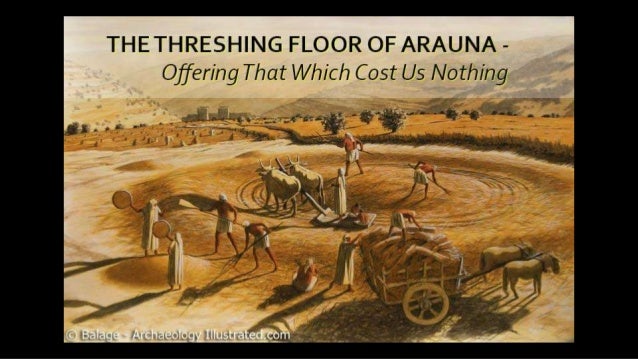
I digress!  Back to today’s reading:  2 Sam 24:18: On that day Gad went to David and said to him, “Go up and build an altar to the Lord on the threshing floor of Araunah the Jebusite.” So David went up, as the Lord had commanded through Gad.”  King David bought that land, under the instruction of God, and it was on that site the first temple was built. The threshing floor of arauna

This is where the Temple will be built:


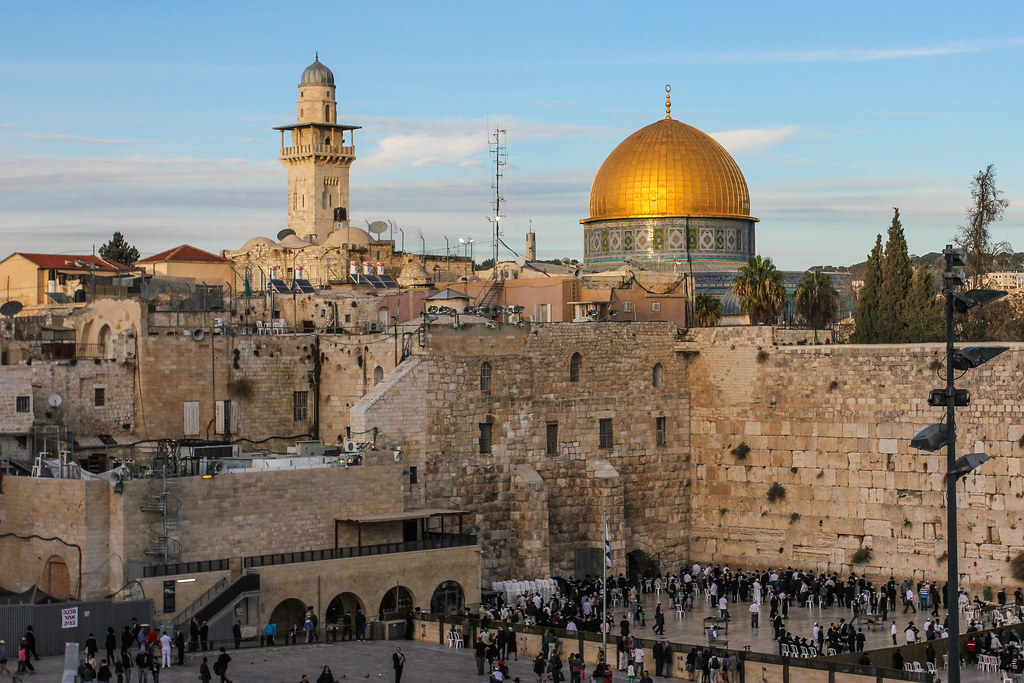
The Dome of the Rock stands in its place today, see picture below.  The rock inside the dome is where Islamic people believe Abraham prepared to sacrifice Isaac….but it is also the same rock where Islamic people believe Muhammad transcended to Heaven to hang out with prophets like Moses and Jesus, so they built a Mosque there until he, Muhammad,  returns).  Anyway, back to facts…😉, the Bible…not fiction 😂)

Western Wall with the Dome of the Rock in background | Flickr

God chose a Threshing Floor.  Threshing is essentially dividing – separating the wheat from the chaff. Threshing is weaved throughout the whole Bible.  Even in the Psalms, we read about the contrast between the wicked and the righteous.  But my favorite is in the Gospel when John the Baptist is baptizing believers he says:

“I baptize you with water for repentance. But after me comes one who is more powerful than I, whose sandals I am not worthy to carry. He will baptize you with the Holy Spirit and fire.  His winnowing fork is in his hand, and he will clear his threshing floor, gathering his wheat into the barn and burning up the chaff with unquenchable fire.”


1 Chronicles 22- David begins collecting an enormous amount of material to build the Temple so the Ark of the Covenant could dwell there.  But we call it Solomon’s Temple (not David’s Temple) for a reason.

‘You have shed much blood and have fought many wars. You are not to build a house for my Name, because you have shed much blood on the earth in my sight.  But you will have a son who will be a man of peace and rest, and I will give him rest from all his enemies on every side. His name will be Solomon, and I will grant Israel peace and quiet during his reign. He is the one who will build a house for my Name. He will be my son, and I will be his father. And I will establish the throne of his kingdom over Israel forever.’

But….keep reading…a big IF is coming.  verse 13:
 so that you may keep the law of the Lord your God. Then you will have success if you are careful to observe the decrees and laws that the Lord gave Moses for Israel. Be strong and courageous. Do not be afraid or discouraged.

Well, what’s your prediction?  Will Solomon observe the decrees and laws??


Don’t forget to read Psalm 30!