Quick Joel Overview

Introduction to Joel | Evidence Unseen

Like most of the Prophecy books, they will have a dual message.  I call it is “Split Screen” Newscast

Breaking News Green Screen | After Effects 2019 Video Template - YouTube

We talked about the difference in Minor Prophet verse Major Prophet books a long time ago.  A minor prophet book is not less important, it is separated by size.  This is a 3 chapter book, but with a major message.  The theme is “The Day of the Lord”.  The book of Joel tells us about Judah’s rescue from captivity and her restoration but it equally details the prophetic message of the Final Judgement in Revelation.

Joel uses the plagues in Exodus and projects them into the Tribulation.  How cool is that!  What is important to keep in mind is just like in Exodus, the plagues were orchestrated by God (not Moses) so will the coming judgment.

Does Joel 2:23-26 promise blessing if we make financial sacrifices? — Day of Atonement | NeverThirsty

If you want to read it now: click here.


Ezekiel Overview

Ezekiel.  Have you ever read it?   We will read Ezekiel for over 2 weeks so I think it is pretty important for me to set the scene. I think you will find it fascinating (of course, God wrote it).  Many of you know I have waited anxiously for this book.

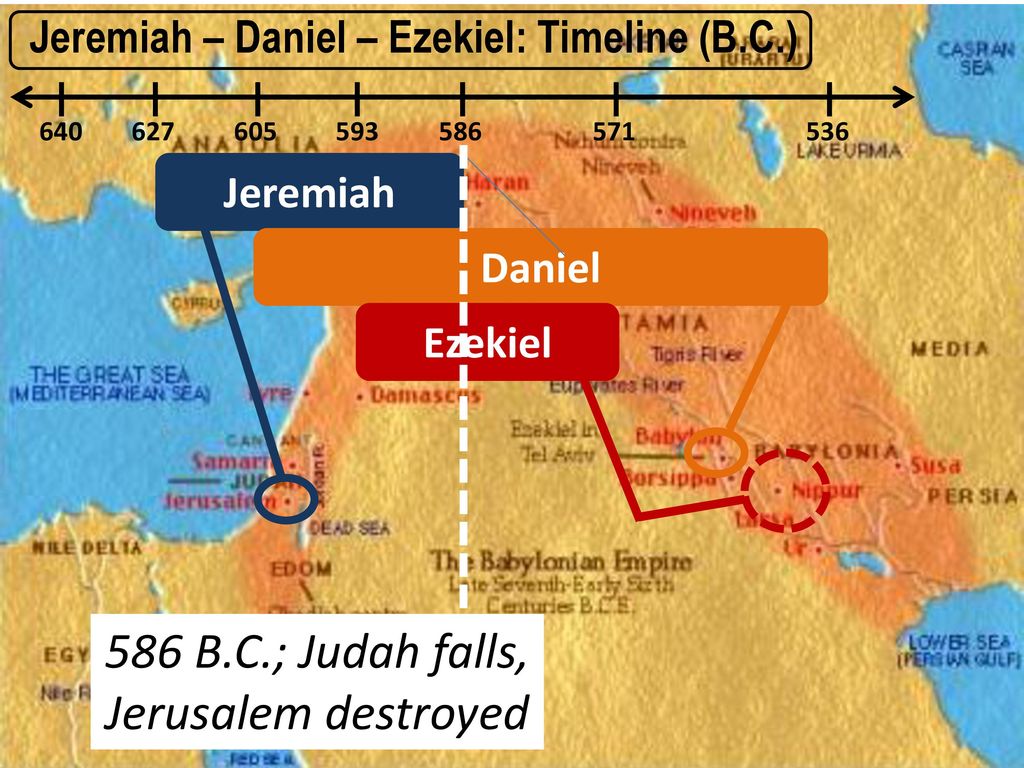
We read about the 3 sieges (is that the word I am looking for?) on the Jewish people that bring Judah into Babylonian captivity.  There were 3 distinct moments where they were invaded and taken into captivity.  We read about them from the perspective of Jeremiah, who was in Jerusalem to see all 3 events over the course of 40 years.  Now read about it from the inside, from a first-person perspective.

King Josiah, remember him? He was a good king.  He found the Book of the Law in the temple when he was repairing it.  He read it and wept when he saw how far his country had gotten from the Lord.  He began a reformation and yes, people began to walk in the ways of the Lord; celebrating Passover, worshiping in the temple, following the Commandments.  Well, Josiah was killed by the Egyptian Pharaoh, Neco at Megiddo.  Four years later Neco was then defeated by Nebuchadnezzar, leaving Babylon as the world power.


Lesson 5 Captivity, Return & Years of Silence - ppt downloadJeremiah was preaching during all this for 40 years and surely had contemporaries ready to follow in his footsteps.  Ezekiel was about 18 yrs old when Nebuchadnezzar took the first group of captives.  Among that group was a familiar name, Daniel.  Daniel was exiled at the age of 15 (with his friends Hananiah, Mishael, and Azariah), while his friend Ezekiel was left behind.  During this time Jeremiah was bringing the message to the people to repent…but they did not.😢

For 10 years, life continued the same, Judah continued to sin.  Then King Jehoiakim, king of Judah,  rebelled against Nebuchadnezzar and he dies.  Jehoiachin became king and once again Nebuchadnezzar attacked Jerusalem this time taking 10,000 captives, and this time Ezekiel was included.  Ezekiel was a few years away from becoming a priest (age 30 eligibility).  When he did turn 30, Ezekiel has a vision.

SO we have 3 men all living at the same time:

  • Jeremiah was at Jerusalem with the Jews during all three stages of the exile, preaching and warning them to repent
  • Ezekiel, who lived with the exiles in Babylon, bringing them a message of hope
  • Daniel, who God put him to live with the Rulers in the court.

timeline for ezekiel and daniel - Saferbrowser Yahoo Image Search Results | Life timeline, Hebrew bible, Daniel

One thing I want you to keep in mind.  Other evil nations were wiped out by the Lord.  Judah however was not, they were in captivity.  The difference is significant, God loves His people  He punished them in captivity as a form of CORRECTION, through their punishment they would come to know the Lord.  And they did. ❤️

Lamentations Overview

Lamentations – Riverside Calvary Chapel

  • Lamentations, Ekha in Hebrew, is a book or wailing and weeping.
  • Lamentations was written in the time between the fall of Judah and the return of the remnant people after 70 years of captivity,

There are 5 poems in this book, each begins at a new chapter (posted at the bottom).  Judah is personified as a woman in this book,  but it is important to remember WHY all this is happening to her.  An avoidable tragedy,  all caused by sin and lack of repenting.  Always read the Bible from God’s character, His Covenant, and His Love.  God is Holy, God is Just, God Perfect, and God punishes sin and disobedience in His timing.

In the Bible, Lamentations follows Jeremiah, who is most likely the author,  and which gave Jeremiah the name the “weeping prophet”.  You could read the last chapter of Jeremiah as the introduction to Lamentations.  However, the Hebrew Old Testament puts Lamentations with a group of books called the Ketubin or “writings”.  The group includes:

  • Song of Songs,
  • Ruth,
  • Ecclesiastes,
  • Esther,
  • Lamentations.

They are in their own category  (our Bible is grouped by category too, that is why we are jumping around a lot) because these books are read at separate Feasts.  To this day, this book is read in Synagogues throughout the world on the ninth day of the fourth month, a day of fasting, to remember the fall of Jerusalem.

Jeremiah’s grief ran deep in his heart for God’s people.  Jeremiah wept for the Jews not just because of the suffering and the exile they would endure, but because they had rejected the word of the Lord.  This saddened Jeremiah to a level of tears and sympathy.

I read once somewhere this question…and it really should make us all think…

What makes a person cry says a lot about that person whether they are self-centered or God-centered.

Habakkuk Overview

Habakkuk asks questions we all have?  Why do bad things happen to good people?  Why do good people suffer?  Why are people starving and others have too much?  Why do natural disasters occur? Where is God in that?

To give you a small recap on History, we need to rewind a little : Assyria had fallen (just as Nahum predicted) So Egypt and Babylon were both contending for the spot of  World Power, which in 605 BC at the Battle of Carchemish, king Josiah was killed (very very sad) Babylon took the spot as the conquerors and everyone fell under Nebuchadnezzar.

Now Habakkuk knew that Judah would fall to this rising power (Babylon).   This was very troubling for Habakkuk who was a worker in the temple as a Levitical Caretaker.  Habakkuk questioned How could God let a wicked nation like Babylon triumph over a nation like Judah. What good could come of that??  Why does God seem indifferent in the face of evil? Why do evil people seem to go unpunished?

This book is written as a dialogue between him and the Lord.  When things don’t make sense, ask the Lord. 

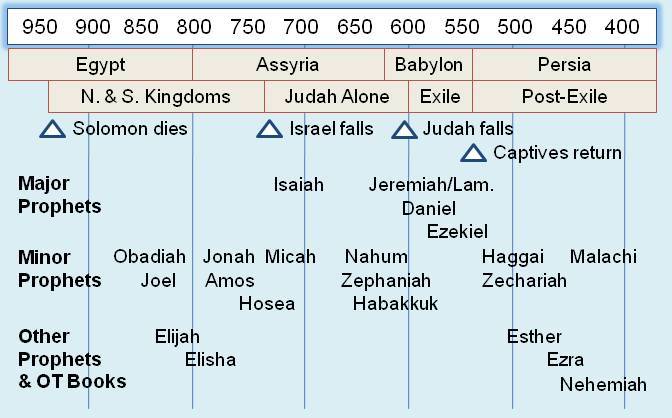
Route 66 Final, Summary of major and minor prophets Diagram | Quizlet

Jeremiah Overview for tomorrow

We are about to read:

  • Jeremiah
  • Ezekiel
  • Daniel

(By the way…if you are behind…you really can jump in here, you won’t be lost.  We have been reading 300 years of the same “message”)-Turn or Burn…Get Right or you will be Left….(I crack myself up!)

We are at the edge of the Babylonian Captivity YIKES!!. Until now the prophets have spoken that one day it will happen.  WELL, Jeremiah “the weeping prophet” is going to bring a message to the people that it will happen now.  We will see it through his eyes: from an “outsider’s perspective”.  He does not go with them into captivity.

  • THEN we will be with Daniel when the first captives are taken into exile.
  • THEN the final wave of captives will be taken and we will experience that through Ezekiel.

Jeremiah is a book not written in chronological order.  Try to imagine it this way, he had this huge scroll and after years and years of preaching his messages he would sporadically write them down, not in order, just as they came back to him (I think of him as my ADHD prophet)😝.  He then had a scribe, Baruch,  write them into a book.  It can, however, be divided into 4 sections:

  1. The call of the prophet Jeremiah (Chapter 1)
  2. The Prophecies of Judah (Chapters 2-45)
  3. The Prophecies to the Gentiles (Chapters 46-51)
  4. The Fall of Jerusalem (Chapter 52)

Jeremiah lived about 100 years after Isaiah preached.  Jeremiah was called to be a prophet in 626 BC.  Let me start with the international situation of the day.

  • The three world powers: Assyria, Babylon, and Egypt. (you knew that)
  • For 300 years Assyria (Ninevah is the capital), ruled the world.  But as predicted,  the country is weakening and Babylon is becoming more powerful.
  • Egypt was the world power before the Exodus and they want it again!
  • About the midpoint in Jeremiah’s life Babylon wins,  defeating Assyria (about 610 B.C.) and 4 years later beats Egypt (Battle of Carchemish).

For 70 years Babylonia will rule the world, while the Jewish people are in the Babylonian captivity.


Week 37 Study Page - Jeremiah 36-52 — MADISON CHURCH OF CHRIST

Look at this crazy good visual…and smile because it is not clear as mud anymore to see something like this!  I LOVE this visual so if you want to print it click here.


Jeremiah was born into the priesthood, his father may have been Hilkiah the priest, who brought the book of the law to king Josiah, which started the great reform.  So we can assume that Jeremiah was religious, but God also had plans for him.  He called him to be a prophet during the most trying times of the Jewish people.  But God has a plan for all of us and sometimes it is the last thing we want to do.

He was called to be a prophet in the 13th year of Josiah’s reign.  Jeremiah’s reign was never a popular one, like most of God’s men, he was beaten for it.  He is called the “weeping prophet” for his sympathy and concern for the people of Judah for their rebellious and imminent doom.  We will hear his lament in the book of Lamentations.

This book is impossible to read chronologically, the end is in the beginning and the beginning in the end. Jeremiah will use props to engage the people to bring a teachable sermon, for example, an almond rod, a boiling cauldron, a marred girdle, a full bottle, a drought, a potters vessel, a broken bottle, 2 baskets of figs, bands and bars, a field, hidden stones, and a book.  Also, to get people to understand who the coming Messiah is to the world,  Jeremiah will refer to him as a Fountain of Living Water, a Great Physician, a Good Shepard, a Righteous Branch, a King, the Redeemer, and The Lord our Righteousness. ❤

Zephaniah Overview for tomorrow

It is hard sometimes to see the overall theme in the Prophecy books.  The key is to look at God’s character, not the people.  Amos, Obadiah, and Nahum were all about God’s judgment; Isaiah was about God’s Salvation, Jonah about God’s Love, and now Zephaniah is about God’s Restoration.  “The great day of the Lord is near” v 1:14 .

Zephaniah:  the first verse is:

The word of the Lord that came to Zephaniah son of Cushi, the son of Gedaliah, the son of Amariah, the son of Hezekiah, during the reign of Josiah son of Amon king of Judah:

So what do we know? If he was the great-great-grandson of Hezekiah he has seen Jerusalem at its best, fall to its worst, and then again at its best with Josiah.

So Zephaniah speaks from experience and will bring a strong message to the people.  He prophesied in the days of King Josiah, born probably while Manasseh was king, I remember he was a BAD king because I use the middle 3 letters in his name as a reminder. 😂

So the little we do know about Zephaniah was that he was royalty, a prince most likely, in the line of Judah.  Fifty years have elapsed since the prophecy of Nahum, and three descendants have taken the throne since Hezekiah, all wicked and idol worshiping.  Social injustice is at an all-time high, the rich are wealthy and the poor are starving.  Idol worship is practiced by most.

Zephaniah will speak of a Loving God, yet a Strong God.  Zephaniah will also speak of the doom to come to Nineveh that Nahum prophesied.   Moreover,  Zephaniah will speak directly of denouncing idolatry.  Remember back when Josiah became king and smashed down the altars and idols.

This book will end very differently than the way it will begin.  It begins in sorrow but ends in Glory.  Zephaniah will tell:

  • That the faithful remnant will be delivered from captivity
  • That the Gentile nation will be converted (Yay!)
  • That one day everyone will worship the Lord, not just in Jerusalem.

Enjoy the read tomorrow…

ONLY 57 days away from the New Testament!!  You have been reading for 218 Days!!  YOU ARE AMAZING!!!!

Nahum Overview for tomorrow

Jerusalem in the context of the Middle East cities of Nineveh and ...

The theme of this book is the destruction of Nineveh.  I know you recognize the name, Nineveh.  But from where?  Jonah!  Jonah about 150 years ago saw Nineveh, the capital of Assyria, repent before his very eyes.  However, much time has passed and they did not stick to their conviction. These people were not just backsliders; they deliberately rejected God.  So now what?  God needs to judge a sinning world.

Nineveh is the capital of Assyria. (Modern day Iraq)  The Assyrians were a huge and cruel nation.  They were warriors that built their kingdom on their pillage from other countries.  Their morals were horrible.  The Assyrian kings kept a detailed record of their conquests and made art of their brutalities to hang on their walls.  They spread complete fear throughout the land in order to keep the nations in line to pay them taxes.

Archaeologists have uncovered some of their documentation: here are the people of Nineveh:

  • Cut off their hands and fingers. Others cut off their noses, ears, and fingers.
  • Put out many of their eyes. Skin them alive and put their skin on the walls of the cities they conquered.
  • Cut off their heads and put them on stakes and line the roads to their city.
  • Swing babies by their ankles and crack their heads against a stone wall.
  • Formed pillars of their corpses.
  • Impaled men on stakes against their city gate.
  • Cut off their privates as a lesson for all lands.
  • Cut off their testicles and tore out their privates like seeds
  • They skinned men alive
  • Cut out their tongues
  • Gauged out their eyes for fun
  • Dismembered their bodies
  • and then made mounds of the skulls as decorations in their empire

To name a few!

God sent Nahum to predict the final doom on Nineveh’s empire.  You have to know how this must have sounded.  Picture this most powerful nation in the world, the world leader (interesting).  Assyria for the past 300 years has built an empire so big it was a fortified city.  The walls were 100 feet high, wide enough for 4 chariots to run side by side on.  The city circumference was 80 miles (close your eyes and picture how far 80 miles is from your house).  It had a moat that was 140 feet wide and 60 feet deep.  It had hundreds of towers for its protection.

Talk about feeling safe and complacent.  But what is a city without the Lord in it? Again…I say interesting!

When you read this story think of it personally and nationally today.  Nineveh was overthrown for its sin.  Her great wealth and power could not save her.  A person or a nation that deliberately and finally rejects God has a very fatal ending.

Hosea Overview for tomorrow

The theme of this book is easy.  God has a covenant relationship with the people of Israel (and you).  God loves His people and has promised to bless them (and you).   BUT they (we) must love God and be faithful to the Word.  The book will present a marriage (covenant) and the spouse becomes unfaithful (Israel).

Reasons for the unfaithful wife (Israel, us) will be clearly spelled out.  See if any are applicable today:

  • Israel does not really know God because they have not read the Scriptures (or taught them to their children…a conversation I had JUST tonight with my friend Randall)
  • They display no concrete loyalty, breaking the covenant (what the scriptures say) in many different ways.  Instead of trusting God, they trust in others or themselves for security.
  • They are not truthful with God-they rationalize their sin or are deceptive. They claim one thing but do another.

Like a wife who deceived her husband and loves two men.  The Israelites claim to be with God but act like they don’t.


Hosea means Salvation.   The prophet Hosea is instructed by God to marry an unfaithful woman, and he found in his own life a vivid illustration of the unfaithfulness of God’s people and the faithfulness of God.

I believe this story to be Historical to show an analogy.  (Some think it is just an allegory, but I think if it wasn’t historical, God would have noted that)

This book is: Love, God’s Covenant, Relationship with His people, Judgement, and Hope.

  • Hosea was the only prophet to come from Israel (northern kingdom).
  • This book is written after the fall of their capital Samaria.
  • After the judgment on God’s people, Israel didn’t turn towards Him, instead, they went further away from the Lord.  The country was in rapid decline morally and politically. (ummmmm)
  • For the past 200 years, the Golden Calf has been the official national god, and God has sent prophet after prophet preaching to the people to change their ways.
  • In the meantime, other world powers (Rome and India) are growing, and they are not even noticing.
  • Buddhism is a new religion and beginning to grow.

The book of Hosea is a one-sided story of faithfulness that represents the relationship between Israel and God.  Gomer is married to Hosea like Israel is married to God like the Church is married to God. (We are HOMER in the story).  

The story has two characters, the faithful husband and the adulterous wife.  She chases after other gods, idolatry, and materialism. 

If you have read the book “Redeeming Love’ by Francine Rivers you know how it ends.  But if you know God you already know how it ends.

-with Forgiveness ❤️.

Micah Overview for tomorrow

The name Micah means “Who is like the Lord”.  He is from the town of Moresheth, about 25 miles outside Jerusalem.  He is speaking to the Southern Nation: Judah (his own nation).  Stop and think about that.  He is not talking to strangers or the other team.  He is giving the message to his OWN.   He spoke during the reign of 3 Judean Kings:

  1. Jotham,
  2. Ahaz,
  3. Hezekiah.

The period before his ministry both nations: Israel and Judah,  are experiencing economic prosperity but lack spiritual communion with God.  Micah’s prophecy predicts the destruction of Judah at the hands of the Babylonians (586 BC) and the restoration of Jerusalem after the 70-year captivity.

In summary, the nation of Judah has false security in the Lord (I think a lot of people do).  However, when we read these prophecy books we can’t help but look at only the judgment,  but we cannot overlook the message of Hope.  The book of Micah points us to the birth of Jesus in Bethlehem.  Micah’s message has 3 key points to it:

  1. Sin
  2. Destruction
  3. Restoration

Micah preached in the walls of Jerusalem (gutsy).  His political platform was the unfair treatment of the poor from the rich.  Micah wanted the people to know that every cruel act to our fellow people was an insult directly to the Lord. 

The sins of this time were no different from the sins of today, idolatry, coveting, oppression of the poor, violence, false prophets, corruption of government, corruption in churches, and dishonesty of the people.

Ouch!

Amos Overview for tomorrow

The Book of Amos addresses:

  •  the excessive pursuit of luxury,
  • self-indulgence
  • oppression of the poor which characterized the period of prosperity and success in the Northern Kingdom of Israel under Jeroboam II.Picture

This book is basically a message of judgment: prophecies of judgment on the nations AND  against Israel. Amos begins with a series of indictments against the seven neighbors of Israel, then Israel itself. The rich are condemned because of their oppression of the poor and for their religious hypocrisy.

True religion demands righteous living, and the way people treat others reveals their relationship with God.  (re-read that)

Amos was a prophet from Judah (southern) with a message to Israel (northern) during the reign of Uzziah (south) and Jeroboam (north). Imagine giving a message of doom to the other team? Ugg. Amos was not a prophet before this, a son of a prophet, or even a priest like Samuel. He was just a sheepherder, however, from his writing, we can assume he was educated.

The two kingdoms during this time are at an all-time high. Peace with neighbors, Assyria was not as powerful, and prosperity was growing. Listen, God is not against prosperity, God is against sin. Unfortunately usually with increased prosperity comes increased sin. Amos goes to Bethel because Bethel was the capital of the Northern Kingdom. Idolatry was everywhere. As you may recall from reading 2 Kings they were worshipping a golden calf and going through the ‘religious motions’. Since the division of the nation into North and South 200 years has passed. God has already sent Elijah, Elisha, and Jonah. With not a single degree of the nation turning from their sinful ways, God now sends people like Amos and Hosea at the same time to warn them. This time the Lord wants the message delivered courageously and directly, and Amos will do just that.

People who think that God is all about wrath and punishment need to dig into the Prophecy books. He loves His people so much that He is giving them opportunity after opportunity of warning to repent! And He is IGNORED.

I knew that you are a gracious and compassionate God, slow to anger and abounding in love, a God who relents from sending calamity. (Jonah 4:2)

I sat in a canoe today in the foothills of South Carolina with my earbuds in and did a “listen through” of the book of Amos.  It was an easy read but I will tell you it rocked my world!  I can’t wait for you to read it. (Honestly, I don’t think you will need to read the blog the next 2 days….you got this!)